
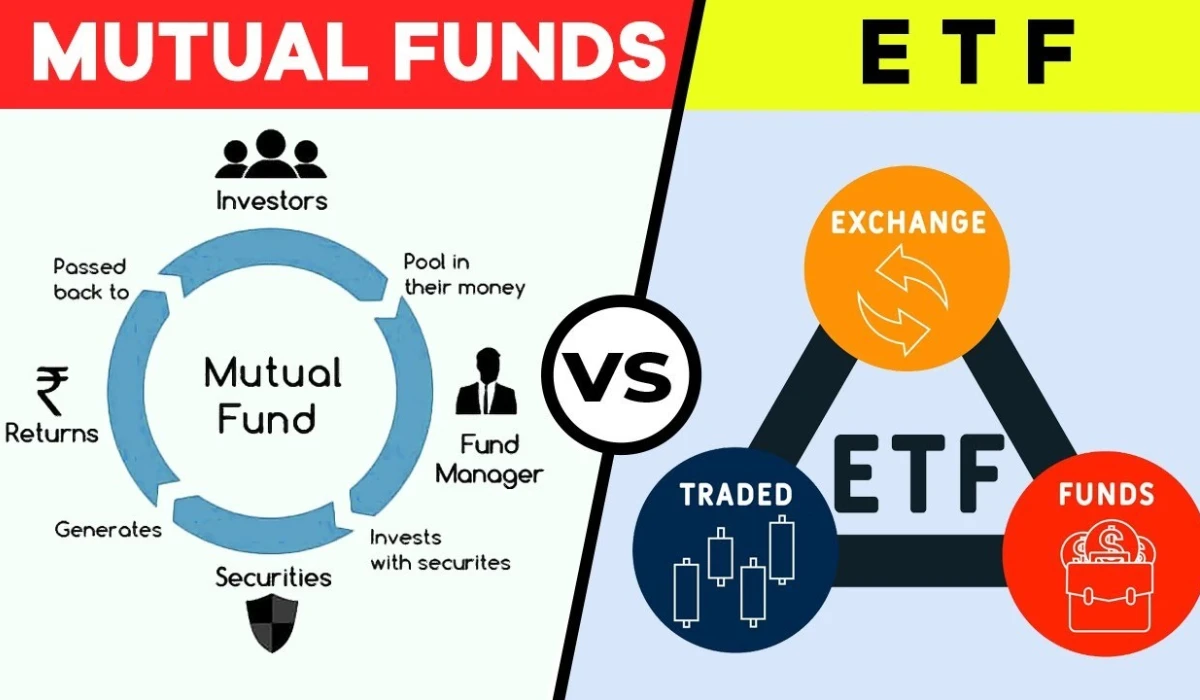
ETFs and mutual funds can both help you build wealth without selecting individual stocks. But they do not work in exactly the same way.
An ETF trades on the stock exchange like a share. A traditional open-ended mutual fund is purchased from an asset management company or investment platform at the applicable Net Asset Value.
ETFs usually offer lower expenses and greater trading flexibility. Mutual funds offer simpler SIPs, automatic investing and a wider selection of actively managed strategies.
The better investment depends on your experience, investment amount, financial goals and willingness to manage market transactions. This detailed ETF vs mutual fund comparison will help you make a practical choice.
Disclaimer: This article is for educational purposes. Returns are not guaranteed, and tax treatment depends on the type of scheme and current tax rules.
What is an ETF?
An Exchange-Traded Fund or ETF is an investment fund whose units are listed and traded on a stock exchange.
Most ETFs track an index, commodity, bond portfolio or specific market segment. For example, a Nifty 50 ETF aims to follow the performance of the Nifty 50 Index before expenses and tracking differences.
Popular types of ETFs in India include:
- Broad-market equity ETFs
- Sector and thematic ETFs
- Gold ETFs
- Silver ETFs
- Debt and government securities ETFs
- International market ETFs
- Smart-beta ETFs
- Factor-based ETFs
According to SEBI’s investor education material, ETF prices change during market hours and investors can buy or sell units on an exchange like ordinary shares.
What is a Mutual Fund?
A mutual fund collects money from multiple investors and invests it in a portfolio of securities. These securities may include shares, bonds, government securities, money-market instruments, gold or units of other funds.
A professional fund management team handles the portfolio according to the scheme’s investment objective.
Major categories of mutual funds include:
- Equity mutual funds
- Debt mutual funds
- Hybrid mutual funds
- Index funds
- Solution-oriented funds
- Fund of Funds
- Money-market and liquid funds
- International mutual funds
Mutual funds can be actively or passively managed. Therefore, comparing all mutual funds with ETFs is not completely accurate.
An index mutual fund and an ETF may track the same index. The biggest differences will then be how they are bought, their costs, liquidity and tracking performance.
ETF vs Mutual Fund:
| Factor | ETF | Mutual Fund |
| Where it is purchased | Stock exchange | AMC website, app, distributor or investment platform |
| Pricing | Changes throughout market hours | Based on applicable end-of-day NAV |
| Demat account | Normally required | Not required for most regular investments |
| Management style | Usually passive | Active or passive |
| Minimum investment | Price of one unit, subject to brokerage rules | Can start from 100 or 500 in many schemes |
| SIP facility | Usually requires broker-based recurring orders | Widely available through automated SIPs |
| Expense ratio | Generally lower | Can be higher, especially in actively managed funds |
| Brokerage | May apply on every transaction | No brokerage, although other scheme costs may apply |
| Liquidity | Depends on trading volume and market makers | Redemption handled by the fund, subject to scheme rules |
| Intraday trading | Available | Not available |
| Purchase price | Market price | Applicable NAV |
| Fund manager involvement | Usually limited to index tracking | Can involve active security selection |
| Best suited for | Cost-conscious and market-aware investors | Beginners and goal-based SIP investors |
How Does an ETF Work?
Suppose a Nifty 50 ETF is trading at 250 per unit. You can place an order for the required number of units through your stockbroker.
Your order is completed when it matches a seller at an available market price. The transaction occurs during stock-market hours.
The ETF’s market price is influenced by:
- Value of the underlying portfolio
- Demand and supply
- Trading activity
- Market-maker participation
- Bid-ask spread
- Broader market conditions
The market price can be slightly higher or lower than the indicative value of the underlying assets. Highly liquid ETFs generally trade closer to their underlying value than thinly traded ones.
How Does a Mutual Fund Work?
Suppose you invest 5,000 in a mutual fund. The amount purchases units based on the applicable NAV after considering the relevant cut-off time and realisation rules.
You do not negotiate a price with another investor. The fund processes your purchase or redemption according to its rules.
If the applicable NAV is 50, an investment of 5,000 would purchase approximately 100 units before considering any applicable charges.
The value of your investment then moves with the NAV of the scheme.
ETF vs Mutual Fund Returns
Neither ETFs nor mutual funds automatically offer higher returns.
Returns primarily depend on:
- Underlying securities
- Market conditions
- Investment strategy
- Portfolio concentration
- Fund management
- Expenses
- Tracking difference
- Time spent invested
- Investor behaviour
ETF returns
Most ETFs aim to reproduce the performance of a benchmark rather than outperform it.
A Nifty 50 ETF will generally try to deliver returns close to the Nifty 50 Total Return Index after accounting for expenses and tracking difference.
It may underperform the index slightly because of fund expenses, cash holdings, rebalancing costs and operational factors.
Actively managed mutual fund returns
An active mutual fund tries to outperform its benchmark by selecting securities and adjusting portfolio allocations.
The fund may outperform, match or underperform its benchmark. Past performance does not prove that it will continue to outperform.
Index mutual fund returns
An index mutual fund works more like a passive ETF. It attempts to follow an index while allowing investors to transact directly with the fund at the applicable NAV.
When comparing an ETF with an index fund tracking the same benchmark, examine expenses and tracking difference rather than past return alone.
Understanding Tracking Error and Tracking Difference
Tracking difference shows how much a passive fund’s return differs from the return of its benchmark over a period.
Tracking error measures how consistently that difference fluctuates.
Two Nifty 50 ETFs may track the same index but deliver slightly different returns because of:
- Expense ratios
- Portfolio rebalancing
- Cash holdings
- Dividend management
- Trading costs
- Operational efficiency
A low expense ratio is useful, but it does not tell the whole story. A fund with slightly higher costs may still track its index more efficiently.
Do You Need a Demat Account?
A demat and trading account is generally required to buy ETFs on an exchange.
This means you must open an account with a broker, understand order types and manage associated charges.
Most mutual fund investments do not require a demat account. You can invest directly through the AMC, a Registrar and Transfer Agent or a supported investment platform.
This makes mutual funds more accessible for people who do not trade in shares.
Which Is Better for Beginners?
For most beginners, a diversified mutual fund or low-cost index fund is easier to manage than an ETF.
The reasons are practical:
- No demat account is required
- SIPs can be automated
- Investment amounts can remain fixed
- No need to study bid-ask spreads
- No temptation to trade throughout the day
However, a beginner who already understands stock-market orders and has a demat account can consider a liquid broad-market ETF.
The word beginner does not determine risk capacity. Age, income stability, dependants, debt, emergency savings and investment horizon matter more.
Which Is Better for Long-Term Investment?
Both can be suitable for long-term investing.
A low-cost ETF can work well for investors who want passive exposure and can manage exchange transactions properly.
A direct mutual fund can work well for investors who value automation, professional management or access to strategies not available through ETFs.
The more important long-term factors are:
- Asset allocation
- Diversification
- Low unnecessary costs
- Tax efficiency
- Regular investing
- Avoiding panic selling
- Periodic portfolio review
A disciplined investor in a suitable mutual fund may perform better than an ETF investor who repeatedly enters and exits the market.
Which Is Better for Short-Term Investment?
Equity ETFs and equity mutual funds are generally not suitable for short-term goals merely because they are easy to buy.
Equity markets can fall sharply without enough time to recover.
For short-term requirements, investors should assess suitable fixed-income or cash-equivalent options based on liquidity, credit risk, taxation and capital-protection needs.
Debt ETFs and debt funds are not automatically risk-free. Their value can change because of interest rates, credit events and market liquidity.
Can You Invest in Both ETFs and Mutual Funds?
Yes, but only when each investment has a clear role.
For example, an investor may use:
- A broad-market ETF for core equity exposure
- An actively managed fund for a selected market segment
- A gold ETF for limited gold allocation
- A debt fund for an appropriate fixed-income objective
The problem begins when multiple schemes hold largely the same securities. This creates portfolio clutter without providing meaningful diversification.
Check portfolio overlap before adding another fund.
FAQs
An ETF is not automatically safer than a mutual fund. Risk depends on the underlying assets and portfolio concentration. A broad-market ETF may be diversified, while a sector ETF can be highly volatile. Similarly, mutual fund risk varies across equity, debt, hybrid and thematic categories.
Some brokers provide recurring ETF investment features, but ETF units are ultimately purchased through the stock exchange. The amount invested may vary with the unit price, and transaction costs can apply. Traditional mutual fund SIPs are generally simpler for investors who want an automatic fixed monthly investment.
ETFs do not guarantee better returns. Most aim to track an index, while active mutual funds try to outperform a benchmark. Actual returns depend on the underlying portfolio, market conditions, expenses, tracking difference and investor behaviour. Compare products following similar strategies before judging their performance.
ETFs listed on Indian stock exchanges are normally purchased and held through a demat and trading account. If you want passive index exposure without opening a demat account, you can consider an index mutual fund purchased directly through the AMC or another supported investment platform.
Not automatically. In India, taxation largely depends on the fund’s underlying assets and legal classification rather than whether it is exchange-traded. Eligible equity ETFs and equity-oriented mutual funds generally receive similar equity taxation, while debt, gold and international schemes may follow different tax rules.