
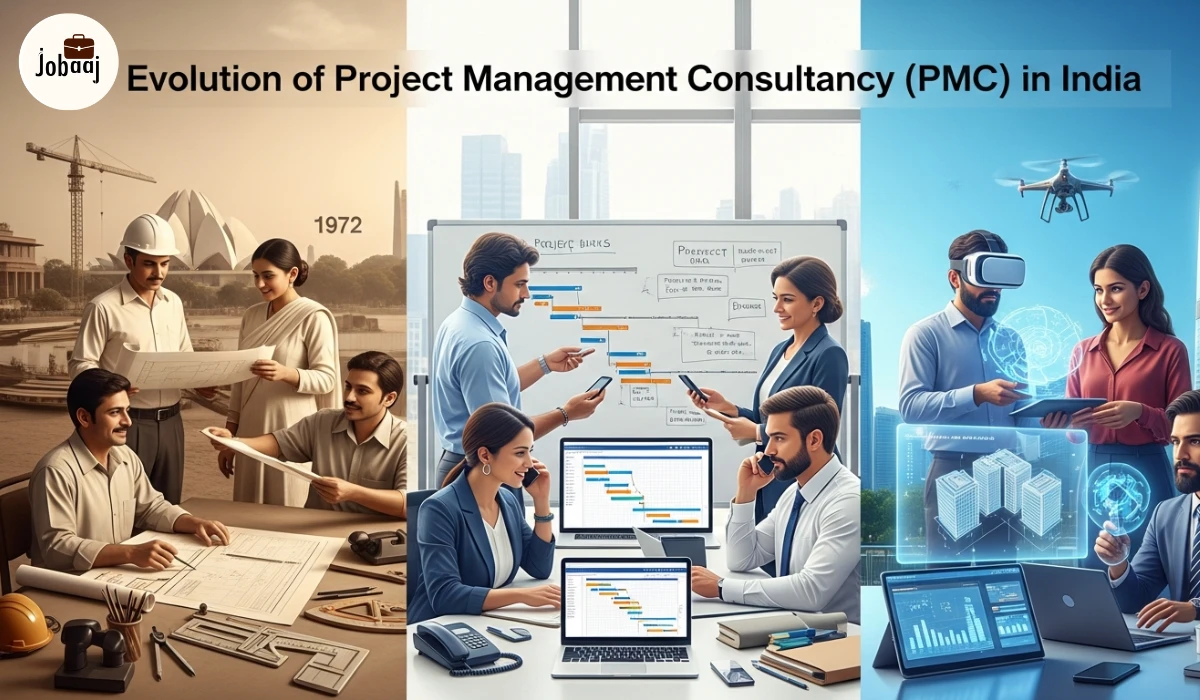
A world where large-scale projects were often chaotic, unorganized, and lacked accountability. Projects would often face delays, go over budget, and, in some cases, fail to meet the expectations of stakeholders. However, as industries began to evolve and as the demands for high-quality, timely project delivery grew, a new breed of professionals emerged: Project Management Consultants (PMCs).
In India, the field of project management consultancy has evolved significantly over the last few decades, transforming the way projects are planned, executed, and delivered. Today, PMCs are not just advisors but integral players who ensure that projects stay on track, within budget, and aligned with stakeholder expectations. In this blog, we’ll take a deep dive into the evolution of PMC in India, highlighting its journey from a nascent concept to a thriving industry.
1. Early Stages of Project Management in India
The concept of project management as a formal profession started taking shape in India in the late 20th century, although its roots trace back to earlier construction projects where project supervision was handled in an informal manner. The 1960s and 1970s saw the rise of large infrastructure projects like highways, bridges, and dams, but the lack of structured management processes often led to inefficiencies.
In these early stages, construction firms would manage projects with a limited focus on timelines and budgets. The general contractor, along with a few engineers, took on multiple roles designing, planning, and executing the projects simultaneously. The need for dedicated project management professionals was evident, but the sector hadn’t fully embraced the importance of project management consultancy yet.
Key Developments:
-
Growth of large public sector undertakings (PSUs).
-
Development of core infrastructure like roads, power plants, and industrial facilities.
-
Lack of formal project management tools or techniques.
2. The 1980s: The Rise of Formal Project Management
By the 1980s, India began to see more complex projects, especially with the advent of globalization and technological advancements. The government started prioritizing infrastructure development, and the private sector began exploring more sophisticated approaches to project delivery. With these changes came the need for formal project management systems to ensure that projects were executed more efficiently.
During this period, many global project management firms started entering the Indian market, introducing tools like Gantt charts, PERT charts, and critical path analysis. This marked the beginning of more methodical and systematic approaches to project management. Local companies began recognizing the value of having third-party consultants to oversee the planning and execution of projects.
Key Developments:
-
Introduction of global project management tools and techniques.
-
Emergence of construction management companies.
-
Realization of the importance of time management and cost control.
3. The 1990s: Emergence of Independent Project Management Firms
The 1990s saw India’s economy open up to global markets, and with it, the demand for sophisticated infrastructure projects soared. The growth of information technology, telecommunications, and real estate further fueled the need for better management practices.
During this decade, Project Management Consultancies (PMCs) began to emerge as independent entities. They offered a range of services, including project planning, budgeting, risk management, and stakeholder communication. This marked a pivotal shift in how large-scale projects were handled. PMCs began to offer not just advisory services but took on execution roles as well, ensuring that the entire lifecycle of the project was being managed effectively.
As the need for quality assurance and project control became more critical, Indian companies started hiring global consultancies for complex projects. This not only increased the quality of project delivery but also introduced a level of international standards in India’s construction and infrastructure sectors.
Key Developments:
-
Rise of independent PMC firms focused on project delivery.
-
Adoption of global standards in project management.
-
Increased reliance on PMCs for large infrastructure and real estate projects.
4. The 2000s: Expansion of Project Management Consultancy Services
In the 2000s, with rapid urbanization and increased foreign investment, the construction and real estate sectors in India saw a significant boom. This period marked a turning point for project management consultants, as their role evolved to meet the growing demand for complex project delivery.
The role of PMCs became more prominent in the private sector, especially in the real estate, IT parks, smart cities, and industrial zones. At the same time, the government also recognized the need for PMCs in overseeing public-sector infrastructure projects like highways, airports, and metros.
The introduction of project management software such as Primavera and MS Project in India helped streamline project planning and execution. PMCs were now not only overseeing cost control and time management but were also responsible for supply chain management, quality control, and ensuring the environmental sustainability of projects.
Key Developments:
-
Adoption of modern project management software.
-
Widespread use of PMCs in real estate, smart cities, and infrastructure projects.
-
Increased focus on environmental sustainability and green buildings.
5. The 2010s: The Digital Transformation of Project Management
The 2010s witnessed a significant shift in how projects were being managed. The digital transformation in the construction industry, driven by tools like Building Information Modeling (BIM) and cloud-based project management systems, changed the landscape of project management consultancy. These tools allowed for real-time collaboration, better data analysis, and smarter decision-making.
PMCs in India adapted to these changes, adopting digital tools to manage not just traditional construction but also IT infrastructure, data centers, and manufacturing plants. The role of a PMC became more data-driven, with consultants providing insights based on analytics to predict project timelines, budgets, and resource requirements more accurately.
This era also saw the rise of construction management software and project management platforms, which made it easier for PMCs to oversee the entire life cycle of a project remotely and in real-time.
Key Developments:
-
The introduction of BIM and cloud-based project management tools.
-
Shift towards data-driven project management.
-
PMCs becoming more involved in digital infrastructure projects.
6. The Future: Project Management Consultancy in 2026 and Beyond
Looking ahead to 2026, project management consultancy in India is expected to continue evolving. As urbanization continues at an exponential rate and sectors like renewable energy, electric vehicles, and smart cities come to the forefront, PMCs will be more essential than ever before.
The focus will shift toward sustainability, AI-driven project planning, and real-time monitoring. With the rise of automation in construction and data analytics, PMCs will rely on advanced tools to predict potential delays, budget overruns, and resource shortages before they happen.
Conclusion
The evolution of Project Management Consultancy in India has been a journey from basic supervision of projects to becoming a critical partner in the execution of large-scale, complex developments. As industries continue to grow and innovate, the role of PMCs will only become more integral in ensuring that projects are delivered on time, within budget, and to the highest quality standards.
For anyone considering a career in project management, this evolution offers exciting opportunities. Whether you’re working in real estate, infrastructure, or technology, PMCs will remain essential to shaping India’s growth story in the years to come.
FAQs
Project Management Consultancy (PMC) oversees the planning, execution, and delivery of construction projects, ensuring they are completed on time, within budget, and to the required quality standards.
PMC in India has evolved from basic supervision of projects to becoming integral to large-scale infrastructure and urban development projects, incorporating advanced technologies like BIM and AI.
Industries such as real estate, infrastructure, IT, transportation, and energy rely heavily on PMCs to manage their complex projects effectively.
PMCs ensure success by providing expertise in project planning, budgeting, risk management, and quality control, while also utilizing modern project management tools and data-driven decision-making.
Technologies like Building Information Modeling (BIM), cloud-based platforms, AI, and machine learning are now widely used by PMCs to streamline project management and improve efficiency.
In the future, PMCs will focus on sustainability, AI-driven planning, and real-time project monitoring, leveraging digital tools to enhance project delivery in sectors like smart cities, renewable energy, and infrastructure.