Imagine you’re a hiring manager, sitting down with a candidate for a job interview. You’ve reviewed their resume, seen their qualifications, and now it’s time to see if they are the right fit for your team. But as the conversation flows, you find yourself straying from the initial questions, focusing on their body language, or maybe even getting sidetracked by personal anecdotes. By the end of the interview, you have a general sense of the candidate's potential, but you're not sure how to evaluate them objectively or compare them with other candidates.
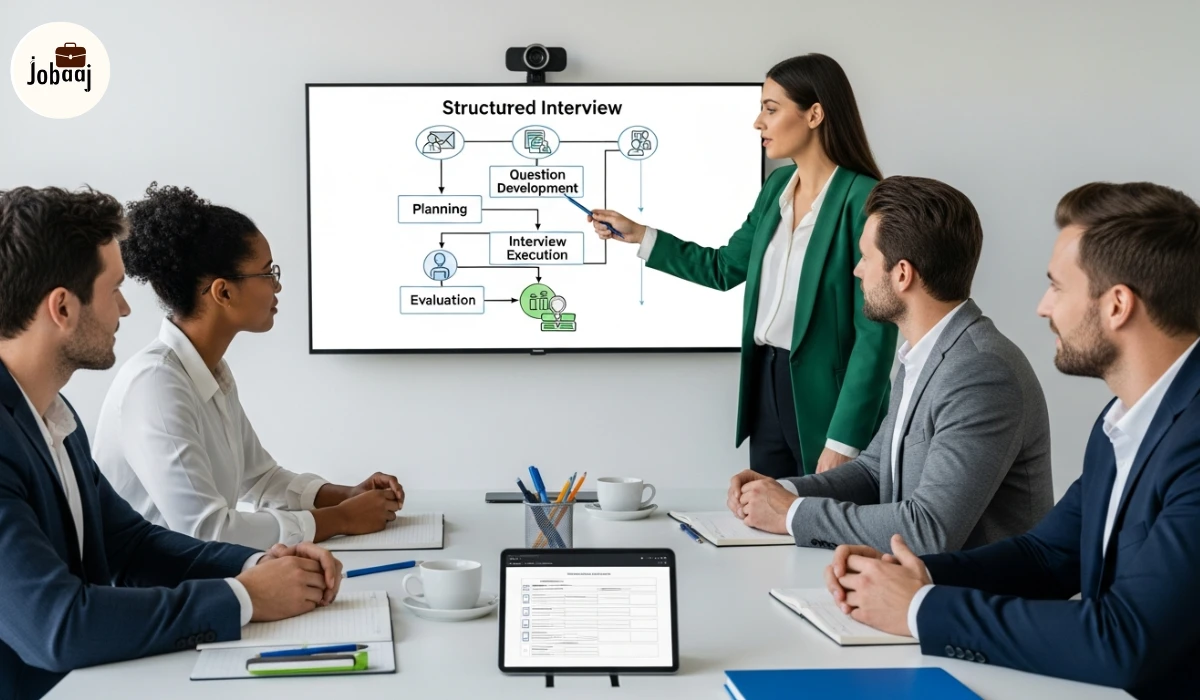
This is where structured interviews come in. Unlike traditional interviews, which can be informal and prone to biases, structured interviews use a predefined set of questions that are asked consistently to all candidates. The goal is to make the hiring process more objective, efficient, and effective. In this blog, we’ll walk you through the steps on how to conduct structured interviews and why they are key to making better hiring decisions.
What is a Structured Interview?
A structured interview is a systematic method of interviewing where each candidate is asked the same set of pre-determined questions. These questions are typically based on the job description, and they focus on assessing the candidate’s skills, experience, and cultural fit for the role. Structured interviews aim to reduce personal biases and provide a more consistent way to evaluate all candidates, making the hiring process fairer and more transparent.
By following a structured approach, you not only gain better insights into a candidate’s qualifications but also make the comparison process easier, as you are measuring everyone against the same criteria.
Why Are Structured Interviews Important?
Structured interviews offer several advantages over traditional unstructured ones:
1.Consistency: Every candidate is asked the same questions, ensuring a fair comparison across all applicants. It minimizes the risk of biased judgments that can arise from personal impressions or off-the-cuff questions.
2.Reduced Bias: Structured interviews are designed to minimize personal biases, such as liking a candidate based on their appearance or demeanor. Since questions are pre-planned and objective, it’s easier to focus on the candidate's skills and experience.
3.Better Predictive Validity: Research shows that structured interviews have higher predictive validity compared to unstructured interviews. This means they are better at forecasting whether a candidate will succeed in the role and contribute positively to the company.
4.Clear Documentation: The structured format makes it easier to document each interview, helping you keep track of the candidate’s responses, strengths, and weaknesses. This is helpful for reference, especially when reviewing multiple candidates.
5.Improved Candidate Experience: Candidates tend to appreciate the fairness and transparency of structured interviews. They know what to expect, which can ease their nerves and improve their performance during the interview.
Steps to Conduct a Structured Interview
Now that we know what a structured interview is and why it's important, let's dive into the steps to conduct one effectively:
1. Prepare Your Interview Questions
The first step in conducting a structured interview is developing your questions. These should be based on the key skills and qualifications needed for the role. Start by reviewing the job description and person specification. This will help you identify the most important competencies and characteristics required for success in the role.
Questions should be job-relevant, behavioral, and open-ended. For example:
-
Instead of asking, “Are you good at problem-solving?” ask, “Can you describe a time when you solved a difficult problem at work?”
-
Instead of asking, “Do you work well in teams?” ask, “Tell me about a time you collaborated with colleagues to complete a project successfully.”
This approach is known as behavioral interviewing, which focuses on past behavior as the best indicator of future performance.
2. Score Each Response
Once the questions are set, establish a scoring system to evaluate the candidate’s responses. This helps in comparing candidates objectively. A common method is using a rating scale (e.g., 1-5) for each question, based on how well the candidate’s response matches the ideal answer.
For example:
-
5: Excellent response, fully meets the job requirement
-
4: Good response, meets most of the job requirement
-
3: Satisfactory, partially meets the job requirement
-
2: Below average, needs improvement
-
1: Poor response, does not meet the job requirement
By scoring each answer, you make it easier to compare candidates’ abilities against the same benchmark.
3. Create an Evaluation Matrix
To further enhance the structure, create an evaluation matrix that aligns your scoring with key competencies for the role. This matrix will help you evaluate multiple candidates using the same criteria, making it easier to identify who is the best fit for the role.
For example, your matrix could look like this:
| Competency | Candidate 1 | Candidate 2 | Candidate 3 |
|---|---|---|---|
| Problem-solving | 4 | 3 | 5 |
| Team collaboration | 5 | 4 | 3 |
| Leadership skills | 3 | 5 | 4 |
| Communication skills | 4 | 3 | 4 |
| Technical expertise | 5 | 4 | 4 |
This format helps in identifying which candidate has the strongest skills for each competency.
4. Ask Follow-Up Questions
During the interview, it’s important to ask follow-up questions based on the candidate’s responses. These questions should allow candidates to elaborate on their initial answers and provide more insight into their thought process and problem-solving abilities.
For example, if a candidate mentions that they handled a challenging project, a good follow-up question could be, “What was the biggest obstacle you faced during that project, and how did you overcome it?”
Follow-up questions help you gauge a candidate’s depth of experience and ability to think critically.
5. Take Notes and Stay Objective
During the interview, take detailed notes, focusing on the candidate’s responses rather than personal impressions. Stick to the scoring system and use your evaluation matrix to stay objective. Remember, the goal is to evaluate the candidate’s fit for the role, not to be swayed by their charisma or other subjective factors.
Best Practices for Structured Interviews
1.Keep Interviews Consistent: Ensure that all candidates are asked the same set of questions in the same order. This ensures consistency and helps reduce bias in the hiring process.
2.Train Your Interviewers: If you’re conducting a structured interview as part of a larger team, make sure all interviewers are properly trained on the interview process and scoring system. Consistency across all interviewers is key to making objective decisions.
3.Focus on the Candidate’s Abilities: Avoid asking irrelevant or off-topic questions, and stay focused on what the candidate can bring to the role. Ensure the questions are directly related to the job’s requirements.
4.Review and Compare: After all interviews are completed, review your notes and compare scores to ensure you’re making decisions based on a fair and objective evaluation.
Conclusion
Structured interviews are an incredibly valuable tool in the hiring process. They ensure that you evaluate candidates based on consistent criteria, reduce bias, and make more informed decisions. By preparing well-thought-out questions, scoring responses objectively, and using an evaluation matrix, you can make the hiring process more efficient, effective, and equitable.
The more structured your interview process, the easier it is to identify the best candidate for the role, ensuring that you hire someone who not only fits the technical requirements but also aligns with your team and company values. By conducting structured interviews, you’re setting your organization up for better hires and ultimately a more successful team.
FAQs
A structured interview is a method of interviewing where each candidate is asked the same set of pre-determined questions, ensuring consistency and fairness in the evaluation process.
Structured interviews help reduce bias, improve consistency, and ensure that all candidates are evaluated based on the same criteria, making the hiring process more objective and informed.
Prepare questions based on the job description, focusing on the key skills and competencies required for the role. Use behavioral questions to assess past performance as an indicator of future success.
Examples include: "Tell me about a time when you had to solve a complex problem," or "How do you handle tight deadlines and multiple projects?" These questions focus on past behavior and job-related skills.
Candidates are evaluated based on their responses to structured questions. Use a rating scale (1-5) to score each answer, and compare the scores across all candidates to make an objective decision.
Structured interviews ensure consistency, reduce bias, improve hiring decisions, and help ensure that the candidate is a good fit for the job and the organization.