A programmer tells a computer exactly how to complete a task. A prompt engineer gives an AI system the right context, instructions and examples, then evaluates whether its response is useful and reliable.
That sounds like a simple difference, but the career decision is more complicated. Prompt engineering is faster to enter and does not always demand advanced coding. Traditional programming, however, offers deeper technical control, wider job opportunities and a more established career path.
Students exploring AI careers should not think of prompt engineering and programming as rival choices. In modern technology roles, the strongest professionals increasingly combine both. They know how to write software, connect AI models with applications and design instructions that make those models behave more reliably.
What Is Prompt Engineering?
Prompt engineering is the process of designing, testing and improving instructions given to generative AI models. These instructions help the model understand the task, expected output, limitations, context and response format.
A prompt can be as simple as asking an AI tool to summarise an article. A professional prompt, however, may define a role, provide reference material, establish rules, show examples and specify how the output must be structured.
For example, a weak prompt might say:
“Analyse this customer data.”
A stronger prompt would identify the dataset, business objective, required metrics, output structure, calculation rules and situations where the model should ask for clarification.
Prompt engineering is therefore not just creative wording. It involves experimentation, evaluation, domain knowledge, logical thinking and an understanding of what AI models can and cannot do.
What Is Traditional Programming?
Traditional programming involves writing instructions in a programming language so that a computer can execute a defined process.
A developer may use Python to analyse data, JavaScript to build a website or Java to create an enterprise application. The programmer defines the logic, variables, conditions, loops, data structures and error-handling rules.
When correctly written, a traditional program usually produces predictable results for the same input and environment. If the program contains a problem, the developer can inspect the code, trace its execution and identify the error.
Programming provides greater control, but it also requires more technical knowledge and development time.
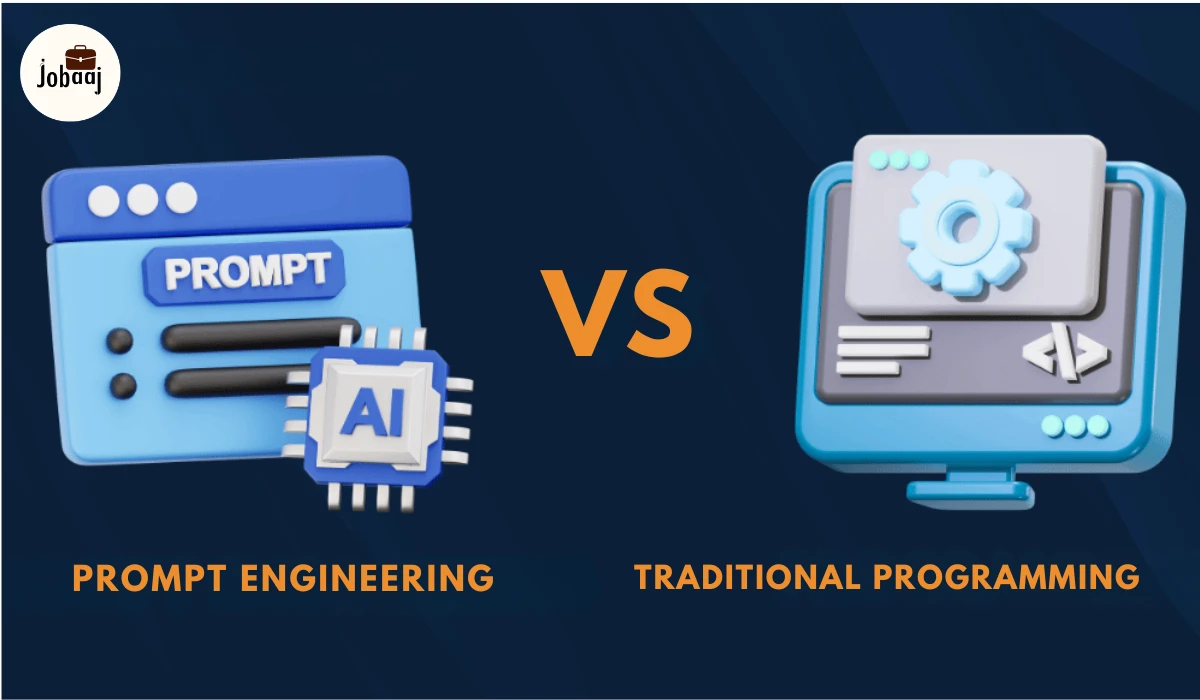
Prompt Engineering vs Traditional Programming:
| Comparison area | Prompt engineering | Traditional programming |
| Main purpose | Guide an AI model toward a useful response | Give a computer explicit instructions |
| Input format | Natural language, examples and context | Programming syntax and structured logic |
| Output behaviour | Probabilistic and sometimes inconsistent | Usually predictable and repeatable |
| Learning difficulty | Easier to begin, harder to master reliably | Steeper initial learning curve |
| Technical control | Limited by the AI model | High control over system behaviour |
| Debugging | Test prompts and evaluate responses | Trace code, logs and errors |
| Accuracy | Requires verification and guardrails | Depends on code, data and system design |
| Coding requirement | Helpful but not always mandatory | Essential |
| Best suited for | AI content, assistants and workflow design | Applications, platforms and automation |
| Career stability | Emerging and often embedded in other roles | Established across industries |
| Scalability | Needs testing and supporting systems | Can be engineered for reliable scale |
| Creativity | High emphasis on language and experimentation | High emphasis on logic and system design |
Key Differences Between Prompt Engineering and Programming
1. Natural Language vs Programming Languages
Prompt engineers usually communicate with AI through natural language. They specify the objective, background, tone, restrictions and desired output.
Traditional programmers use formal languages such as Python, Java, C++, JavaScript or SQL. These languages follow strict syntax, and even a small mistake can cause the program to fail.
Natural language feels more accessible, but it can also be ambiguous. A prompt may appear clear to a person while still allowing the AI model to interpret it in several ways.
Programming languages reduce that ambiguity by using explicit rules.
2. Probabilistic Output vs Deterministic Logic
Generative AI models produce responses based on learned patterns and probabilities. The same prompt may sometimes generate slightly different answers.
Traditional software generally follows predetermined logic. If the input and environment remain unchanged, the output is usually consistent.
This distinction matters in sensitive areas. A creative marketing assistant can tolerate some variation, but a payroll calculation or banking transaction needs strict and repeatable logic.
3. Instructions vs Implementation
A prompt engineer explains what the AI should accomplish and how the response should appear.
A programmer implements the actual process. The developer decides how information will be stored, calculated, secured and transferred between different parts of a system.
Prompt engineering can influence an AI model’s behaviour, but it cannot replace the infrastructure surrounding that model.
4. Testing Responses vs Debugging Code
When a prompt performs poorly, the problem may not produce a clear error message. The prompt engineer must inspect the response and determine whether the issue came from missing context, unclear instructions, weak examples or the model’s limitations.
Programming errors are often easier to trace systematically. Developers can use logs, debuggers, automated tests and error messages to locate problems.
Prompt testing is more similar to experimentation. Programming debugging is generally more structured.
5. Model Dependence vs System Control
A prompt that works well with one AI model may behave differently with another. Its performance can also change when the model is updated.
Traditional code is also affected by frameworks and operating environments, but developers usually have more control over dependencies, versions and execution rules.
A professional AI application therefore should not depend on one clever prompt. It needs evaluations, fallback behaviour, data controls and continuous monitoring.
6. Speed of Prototyping
Prompt engineering can produce a working prototype quickly. A student may create an AI-based content assistant, interview simulator or document analyser within hours.
Traditional programming usually takes longer because developers must design the interface, logic, database, security and error handling.
However, a quick AI prototype is not automatically ready for real users. Building a secure and scalable product still requires conventional software engineering.
7. Entry Barrier
A beginner can start experimenting with prompt engineering without learning a programming language. Strong writing, logical thinking and subject knowledge provide a useful foundation.
Traditional programming requires students to understand syntax, algorithms, data structures and debugging. The initial learning period is longer, but the skills can be applied across a wider range of technical careers.
8. Accuracy and Reliability
An AI response can sound confident while containing incorrect information. Prompt engineers must design verification methods and prevent users from assuming that fluent output is always factual.
Traditional programs can also produce incorrect results when their logic or input data is wrong. However, their execution is generally more traceable.
Neither approach guarantees accuracy. The difference lies in how errors appear and how they are controlled.
9. Security Risks
Prompt-based applications face risks such as prompt injection, sensitive-data exposure, harmful output and users attempting to bypass instructions.
Traditional applications face threats such as insecure code, weak authentication, database attacks and software vulnerabilities.
Both fields require security awareness. Simply adding a sentence such as “ignore malicious instructions” is not enough to protect an AI system.
10. Career Structure
Software development has a well-established progression from junior developer to senior developer, technical lead, architect or engineering manager.
Prompt engineering is newer and less standardised. Many businesses need prompting skills, but they may hire for titles such as AI product specialist, conversational AI designer or generative AI developer instead of “prompt engineer.”
This is the weakest point of pursuing prompt engineering as a standalone career. The skill is valuable, but the job title itself may not remain separate as AI tools become easier to use.
How Prompt Engineering Works in Practice
Professional prompt engineering normally follows an iterative process.
1. Define the Task: The engineer identifies what the user wants the AI system to accomplish and what a successful response should contain.
2. Add Relevant Context: The prompt may include company policies, product details, customer information or reference documents.
3. Establish Constraints: The engineer specifies what the model must avoid, how long the response should be and which sources it may use.
4. Provide Examples: Examples show the model what a strong input and output look like. This can improve structure and consistency.
5. Test Different Scenarios: The prompt is evaluated using common, unusual and potentially harmful inputs.
6. Measure the Results: Teams may evaluate accuracy, relevance, consistency, safety, response time and cost.
7. Improve and Monitor: Prompts are revised when models, user behaviour or business requirements change.
How Traditional Programming Works in Practice
Traditional software development follows a more structured engineering cycle.
1. Understand Requirements: Developers identify user needs, system limitations and expected features.
2. Design the System: They plan the application architecture, data flow, database and user interface.
3. Write the Code: The logic is implemented using suitable programming languages and frameworks.
4. Test the Application: Developers perform unit, integration, security and user-acceptance testing.
5. Deploy the Software: The application is released to a server, cloud platform or user device.
6. Maintain and Improve It: Teams fix defects, strengthen security and add new functionality over time.
Popular Tools Used in Prompt Engineering
Prompt engineering may involve more than a chatbot interface. Common categories include:
- Generative AI platforms
- API testing tools
- Python notebooks
- Prompt-management systems
- Model evaluation platforms
- Vector databases
- Retrieval-augmented generation frameworks
- Automation platforms
- Version-control tools
- Analytics and monitoring systems
Beginners can start with an AI interface and spreadsheets for documenting tests. Advanced learners should understand APIs, JSON, Python and retrieval-based AI systems.
Popular Tools Used in Traditional Programming
The tools depend on the chosen development field:
- Languages: Python, Java, JavaScript, C++, C# and SQL
- Editors: Visual Studio Code, IntelliJ IDEA and PyCharm
- Version control: Git and Git-based repositories
- Databases: MySQL, PostgreSQL, MongoDB and SQL Server
- Frameworks: React, Angular, Django, Flask, Spring and .NET
- Testing: Pytest, JUnit, Jest and Selenium
- Cloud platforms: AWS, Microsoft Azure and Google Cloud
- Container tools: Docker and Kubernetes
Students do not need to learn all these tools. One language, one development path and a few complete projects are enough to start.
Salary Expectations in India
| Role | Approximate entry-level salary |
| AI Prompt or Content Specialist | 3 lakh– 6 lakh |
| AI Quality Analyst | 3.5 lakh– 7 lakh |
| Generative AI Associate | 4 lakh– 8 lakh |
| Junior Software Developer | 3 lakh– 7 lakh |
| Frontend Developer | 3 lakh– 7 lakh |
| Backend Developer | 4 lakh– 8 lakh |
| Full-Stack Developer | 4 lakh– 9 lakh |
| AI Application Developer | 5 lakh– 12 lakh |
Higher-paying AI roles generally require more than prompt-writing ability. Employers may expect Python, APIs, machine learning fundamentals, retrieval systems, cloud tools and software-development experience.
Students should therefore be cautious about courses promising extremely high salaries after learning a few prompt templates.
FAQs
Neither is universally better. Prompt engineering is useful for guiding generative AI and developing quick prototypes, while traditional programming provides greater technical control and broader career opportunities. Students seeking a sustainable technology career should learn programming fundamentals and treat prompt engineering as a complementary AI skill.
You can begin prompt engineering without coding, especially for content, research and workflow-related tasks. However, professional AI roles increasingly require Python, APIs, JSON, testing and data-handling skills. Coding allows you to move beyond individual prompts and build complete, reliable AI applications.
Prompt engineering and AI coding tools may automate some repetitive development tasks, but they cannot completely replace software developers. Professionals are still required to understand requirements, design system architecture, review generated code, protect sensitive data, test applications and maintain software after deployment.
Students can start with basic prompting to understand how generative AI responds to instructions. However, they should begin learning a programming language soon afterward. Python is suitable for AI and data analytics, while JavaScript is useful for web development. Learning both through practical projects creates a stronger career foundation.
Prompt engineering will remain valuable, but dedicated prompt engineer positions may be less common than broader roles in AI development, evaluation, automation and product design. Students should combine prompting with programming, domain expertise, data skills and model evaluation to remain competitive as generative AI becomes easier to use.