
Six Sigma is one of those career skills that sounds technical at first, but the idea is actually simple.
It helps companies reduce mistakes, improve quality, save money, and make processes smoother. Whether it is a factory producing cars, a hospital reducing patient waiting time, a bank improving loan processing, or an e-commerce company reducing delivery errors, Six Sigma helps teams find what is going wrong and fix it with data.
For students and professionals who want a career in operations, quality management, business analytics, manufacturing, supply chain, healthcare, BFSI, IT services, or process improvement, Six Sigma can be a strong career booster.
But here is the important part: Six Sigma certification alone is not magic. It becomes valuable when you understand the tools, apply them to real problems, and show measurable improvement.
What Is Six Sigma?
Six Sigma is a data-driven method used to improve business processes by reducing defects, errors, delays, and variation.
In simple words, it helps answer questions like:
- Why are customers complaining?
- Why is production taking too long?
- Why are invoices getting delayed?
- Why are products failing quality checks?
- Why is the same mistake happening again and again?
Instead of guessing, Six Sigma uses data, root-cause analysis, process mapping, and improvement techniques to solve problems properly.
Six Sigma became popular in manufacturing, but today it is used across industries such as healthcare, banking, IT, logistics, retail, telecom, consulting, and service operations. The core aim is to improve quality and consistency by reducing process variation. Investopedia describes Six Sigma as a data-driven methodology focused on reducing defects and improving business processes.
Why Six Sigma Matters Today
Companies are under pressure to work faster, reduce waste, control costs, and improve customer experience. That is exactly where Six Sigma becomes useful.
A business does not only lose money because of big failures. It also loses money through small repeated mistakes. Late deliveries, wrong entries, rework, poor communication, customer complaints, long approval cycles, and quality defects all create hidden losses.
Six Sigma professionals help companies identify these losses and remove them.
This is why Six Sigma is still relevant even when AI, automation, and analytics are growing. In fact, the future of work is becoming more skill-based. The World Economic Forum’s Future of Jobs Report 2025 highlights analytical thinking, quality control, resource management, operations, and technological literacy as important skills for the future workplace.
That makes Six Sigma useful for people who want a practical business skill that connects data, operations, quality, and problem-solving.
Six Sigma vs Lean Six Sigma
Many students get confused between Six Sigma and Lean Six Sigma.
Six Sigma focuses on reducing defects and variation. It asks: how can we make the process more accurate and consistent?
Lean focuses on reducing waste. It asks: what steps are unnecessary, slow, costly, or not adding value?
Lean Six Sigma combines both. It helps companies reduce errors and remove waste at the same time.
For example, if a company takes 10 days to process customer refunds, Lean will help remove unnecessary steps. Six Sigma will help reduce errors in refund approvals. Together, Lean Six Sigma can make the refund process faster and more accurate.
Six Sigma Methodology: DMAIC Explained
The most common Six Sigma method is DMAIC. It stands for Define, Measure, Analyze, Improve, and Control.
Define
This step identifies the problem clearly. You define what needs to improve, who is affected, and what success will look like.
For example: customer complaints increased by 20% in the last three months.
Measure
This step collects data. You measure the current process to understand how serious the problem is.
For example: how many complaints are received, which department is responsible, how long resolution takes, and where the delay happens.
Analyze
This step finds the root cause. You do not blame people. You study the process.
For example: complaints may be increasing because product details are entered incorrectly during order processing.
Improve
This step creates and tests solutions. The goal is to fix the root cause, not just the surface problem.
For example: create a validation checklist, automate a data-entry field, or train the team on the correct process.
Control
This step makes sure the improvement stays in place.
For example: track weekly complaint numbers, create a dashboard, assign ownership, and review process quality regularly.
DMAIC is one reason Six Sigma is respected. It gives a structured way to solve business problems instead of relying on random trial and error.
Six Sigma Certification Levels
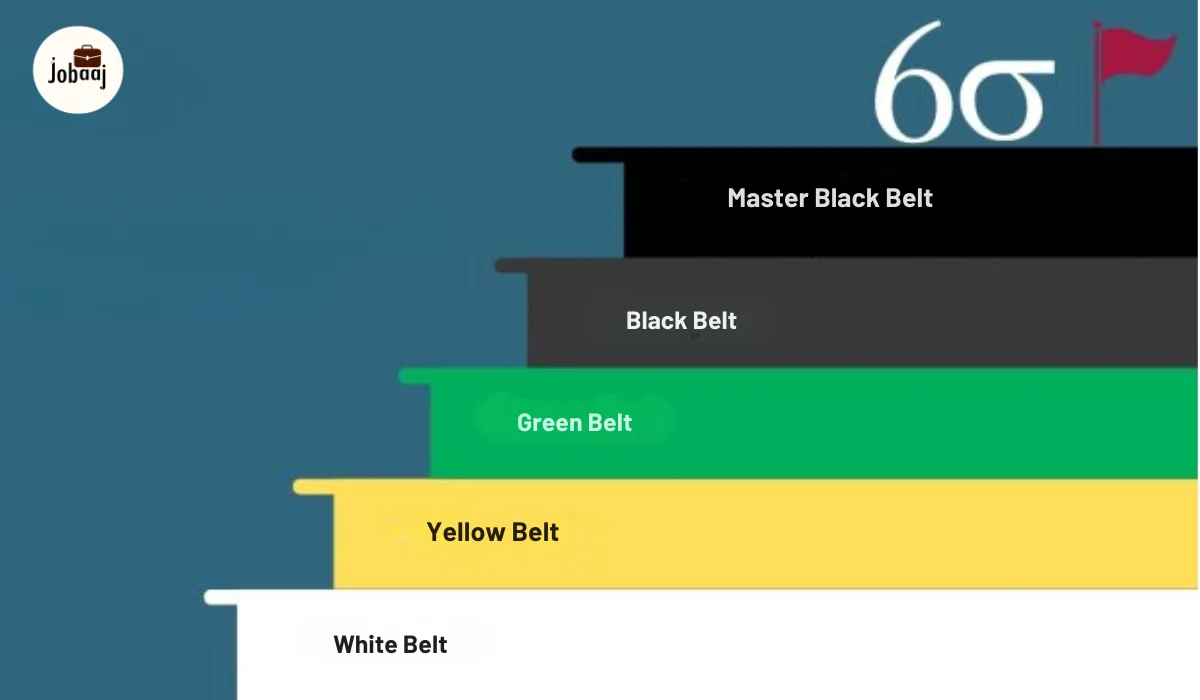
Six Sigma certifications are usually divided into belt levels. Each belt shows a different level of knowledge, responsibility, and project involvement.
The common levels are:
- White Belt
- Yellow Belt
- Green Belt
- Black Belt
- Master Black Belt
ASQ explains that Green Belts usually support data collection and analysis or lead Green Belt projects, Black Belts lead problem-solving projects and coach project teams, and Master Black Belts train and guide Black Belts and Green Belts at a program level.
1. Six Sigma White Belt
White Belt is the beginner level.
It is suitable for students, freshers, interns, and professionals who want a basic understanding of Six Sigma. At this level, you learn what Six Sigma is, why quality improvement matters, and how process improvement works.
White Belt does not usually prepare you to lead projects. It gives awareness.
White Belt is good for awareness, but it is not enough for strong job opportunities. Treat it as a starting point, not a career-changing certification.
2. Six Sigma Yellow Belt
Yellow Belt is the next level after White Belt.
It teaches basic Six Sigma concepts, problem-solving tools, process mapping, and improvement thinking. Yellow Belt professionals usually support improvement projects but do not lead complex projects.
IASSC’s Yellow Belt exam is a closed-book proctored exam with 60 questions and a 2-hour time limit, which shows that even beginner-level certification has a structured assessment format.
Yellow Belt can help you show interest in quality and operations roles. It is useful for internships, entry-level process roles, and management trainee profiles.
3. Six Sigma Green Belt
Green Belt is one of the most popular Six Sigma certifications.
This level is for people who want to understand Six Sigma properly and work on improvement projects. Green Belts may lead small projects or support Black Belt-led projects.
They understand data collection, root-cause analysis, process improvement tools, and basic statistics.
Green Belt has strong practical value because it shows that you can participate in real improvement projects. For many professionals, Green Belt is the most practical starting point.
ASQ India states that Yellow Belt requires no prior experience, while Green Belt is commonly suited for working professionals and may require field experience depending on the certification route.
4. Six Sigma Black Belt
Black Belt is an advanced certification.
Black Belt professionals lead complex improvement projects. They are expected to understand statistics, process behavior, project leadership, team management, and financial impact.
A Black Belt is not just a technical person. They also need leadership skills because they work with teams, managers, and stakeholders.
Black Belt can be powerful for professionals who already have work experience. It can help with roles in quality management, operational excellence, consulting, manufacturing excellence, process transformation, and business improvement.
ASQ positions the Black Belt as a professional who leads quality improvement projects and develops advanced problem-solving capability.
5. Six Sigma Master Black Belt
Master Black Belt is the expert level.
These professionals train Black Belts and Green Belts, design Six Sigma programs, guide large transformation projects, and work closely with leadership.
This level is usually not for beginners. It is for experienced professionals who have already led multiple improvement projects.
Master Black Belt is useful for senior leadership and consulting roles. It can open opportunities in large organizations, multinational companies, and training or advisory roles.
Which Six Sigma Level Should You Choose?
Choosing the right level depends on your background.
| Profile | Best Certification Level |
| Complete beginner | White Belt or Yellow Belt |
| College student | Yellow Belt |
| Fresher interested in operations | Yellow Belt or Green Belt |
| MBA student | Green Belt |
| Engineering graduate | Green Belt |
| Working professional with 2-5 years experience | Green Belt |
| Quality or operations manager | Black Belt |
| Senior process leader | Black Belt or Master Black Belt |
| Consultant or trainer | Black Belt or Master Black Belt |
Students should usually start with Yellow Belt or Green Belt. Working professionals with some experience can directly target Green Belt. Black Belt is better when you already understand business processes and have handled projects.
Top Six Sigma Certification Providers
There is no single universal global authority for all Six Sigma certifications. Different organizations offer their own certification structure, exam format, and requirements. Investopedia also notes that Six Sigma certification is not standardized by one universal governing body.
Some known providers include:
- ASQ
- IASSC
- CSSC
- TUV-related training bodies
- KPMG learning programs
- Coursera university-linked programs
- Simplilearn and other professional training platforms
- Company-sponsored internal Six Sigma programs
IASSC provides independent third-party Lean Six Sigma certification for Yellow Belt, Green Belt, and Black Belt levels.
Conclusion
Six Sigma is not just a certificate. It is a way of thinking.
It teaches you how to look at a problem, measure it, find the root cause, improve the process, and make sure the solution stays stable.
For students, Six Sigma can improve resume value and build practical business understanding. For working professionals, it can support better roles, higher responsibility, and stronger career growth.
The best approach is simple.
- Start with the right belt.
- Learn the tools properly.
- Work on a practical project.
- Connect your learning with real business results.
- Keep upgrading with analytics and digital skills.
Six Sigma will not make your career overnight, but it can give you a strong edge if you use it properly.
FAQs
Six Sigma certification proves that you understand quality improvement, process improvement, and defect reduction methods. It is divided into belt levels such as White Belt, Yellow Belt, Green Belt, Black Belt, and Master Black Belt. Each level shows a different depth of knowledge and project responsibility.
Yellow Belt is usually best for beginners because it explains basic Six Sigma concepts, tools, and process improvement methods. Students and freshers can start with Yellow Belt. If you already have some work experience or business understanding, Green Belt can be a better long-term option.
Yes, Six Sigma is useful for students who want careers in operations, quality, supply chain, analytics, manufacturing, or business management. It helps students understand how companies solve real process problems. However, students should also build small projects instead of depending only on the certificate.
Salary after Six Sigma certification depends on your role, experience, industry, and project exposure. Entry-level roles may start around ₹2.5 LPA to ₹6 LPA, while experienced Green Belt and Black Belt professionals can earn much higher. Senior quality and operational excellence roles can cross ₹15 LPA to ₹25 LPA.
Six Sigma and MBA are not the same. MBA gives broader business knowledge, while Six Sigma gives specialized process improvement skills. For operations, supply chain, consulting, and quality roles, Six Sigma can be a strong add-on to an MBA. The best option depends on your career goal.