
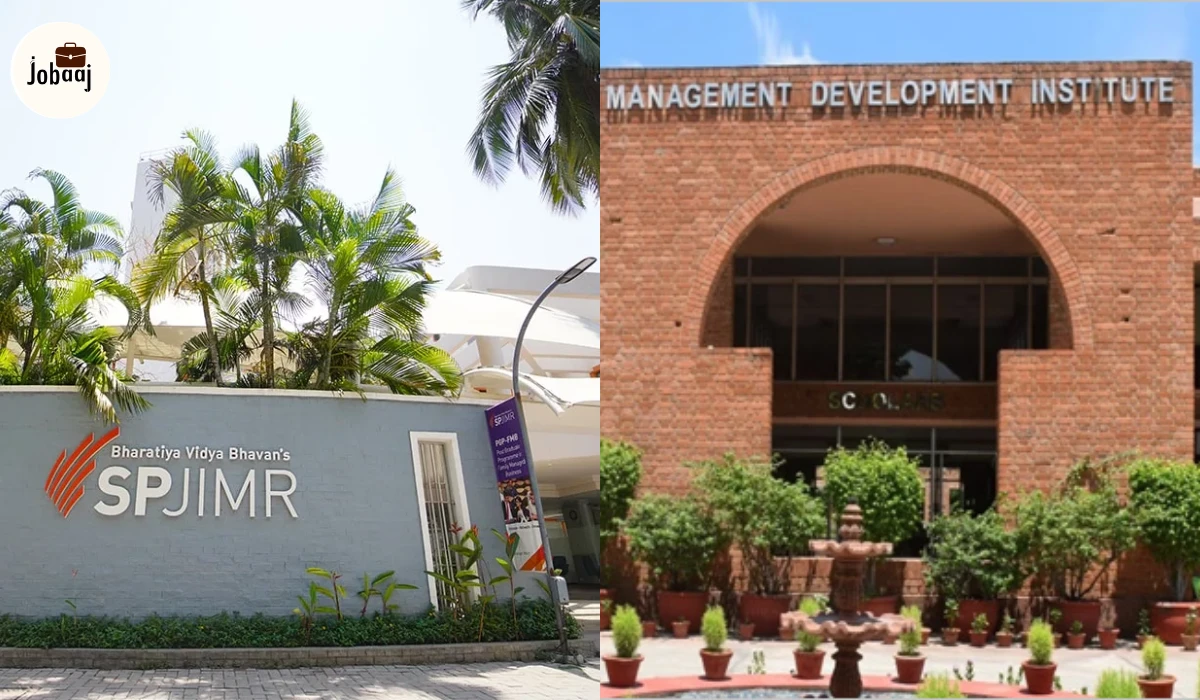
SPJIMR Mumbai and MDI Gurgaon are both serious alternatives to the older IIMs for candidates targeting top-tier management education in India.
Both attract recruiters from consulting, finance, FMCG, technology and general management. Both have established alumni networks. Both can lead to compensation well above the average Indian MBA outcome.
But if you receive offers from both, the choice is not completely equal.
Based on the latest placement outcomes, programme cost and flagship batch performance, SPJIMR currently has a slight overall edge.
MDI Gurgaon, however, remains exceptionally strong for consulting, corporate roles and candidates who value its large recruiter ecosystem and Delhi-NCR location.
So the comparison is better understood as:
SPJIMR = slightly stronger current placement-to-fee equation
MDI Gurgaon = excellent consulting exposure, broad corporate recruitment and strong MBA brand
SPJIMR vs MDI Gurgaon: Quick Comparison
| Factor | SPJIMR Mumbai | MDI Gurgaon |
| Flagship programme | PGDM | PGDM |
| Duration | 2 years | 2 years |
| Location | Mumbai | Gurugram |
| Entrance exam | CAT / GMAT for eligible applicants | CAT for Indian flagship applicants |
| Current programme fee | 24.86 lakh* | 26.55 lakh |
| Latest average CTC | 33.75 LPA** | 29.5 LPA |
| Latest median CTC | 32.85 LPA** | 29 LPA |
| Latest highest CTC | 75 LPA** | 97.5 LPA overall placement process |
| Consulting presence | Very strong | Very strong |
| Finance exposure | Excellent | Excellent |
| Selection style | Strong profile emphasis | CAT + WAT/GD/PI + profile factors |
| NIRF Management 2025 | 20 | 9 |
| Overall edge | SPJIMR | Strong alternative |
*SPJIMR's current indicative fee includes tuition and basic hostel/accommodation.
**SPJIMR reports PGDM and PGDM (BM) together for its Class of 2026 placement figures.
MDI's current 26.55 lakh fee for the flagship 2026–28 PGDM includes tuition, boarding, lodging, learning materials and other listed programme charges.
Placements: SPJIMR Currently Has the Edge
For most applicants comparing these two colleges, this is the most important section.
SPJIMR's Class of 2026 achieved:
- Average CTC: 33.75 LPA
- Median CTC: 32.85 LPA
- Highest CTC: 75 LPA
- 46% of the batch received PPOs
- 68% of offers were 30 LPA or higher
- 94% of offers were 25 LPA or higher
SPJIMR reported 100% placements across its PGDM and PGDM (BM) Class of 2026, covering 356 participants.
The median is particularly impressive.
A high average can sometimes be pushed upward by a few exceptional offers. When the median itself is 32.85 lakh, it suggests strong compensation across a large portion of the batch.
MDI Gurgaon Placements
MDI's latest official 2024–26 placement report shows equally serious corporate participation.
For the flagship PGDM batch:
- Average CTC: 29.5 LPA
- Median CTC: 29 LPA
- Top 50% average: 35.4 LPA
- Top 25% average: 40.5 LPA
- Top 10% average: 45.7 LPA
MDI's broader placement process involved 157 companies, including 75 new recruiters.
The flagship PGDM batch itself had 313 students, with consulting accounting for 35.1% of PGDM offers.
That makes MDI extremely strong it simply trails SPJIMR on current average and median compensation.
Placement Winner: SPJIMR
If placement numbers are your primary deciding factor, SPJIMR wins this round.
But the gap is not wide enough to dismiss MDI. A 29 lakh median from the flagship programme still places it firmly among India's stronger management schools.
Consulting: This One Is Very Close
Candidates targeting consulting should take both colleges seriously.
At SPJIMR, consulting represented 40% of all offers in the Class of 2026 placement season.
Recruiters included names such as:
- BCG
- McKinsey
- Kearney
- Accenture Strategy
- Deloitte
- EY-Parthenon
- PwC
- KPMG
MDI Gurgaon also has a major consulting presence.
Consulting contributed 35.1% of flagship PGDM offers, while its latest recruiter list included firms such as:
- McKinsey & Company
- Boston Consulting Group
- Accenture Strategy & Consulting
- Deloitte
- EY
- KPMG
- PwC
- Infosys Consulting
Consulting Verdict
Very slight edge to SPJIMR based on the latest offer share and overall placement outcome, but both are excellent consulting campuses.
Your profile, case-interview ability and prior experience will matter more than the difference between the two brands.
Finance: Mumbai Gives SPJIMR an Interesting Advantage
Both schools place well into finance.
SPJIMR's latest Finance cohort attracted participation from firms including:
- Goldman Sachs
- Morgan Stanley
- Bank of America
- Barclays
- Citi
- Nomura
- HSBC
- Kotak
- Standard Chartered
BFSI and investment banking/private-equity-related hiring represented 32% of offers in SPJIMR's Finance cohort.
MDI's finance recruiter pool is also impressive.
Its latest placement report includes firms such as:
- Goldman Sachs
- JPMorgan Chase
- Morgan Stanley
- Nomura
- American Express
- HSBC
- D.E. Shaw
- CRISIL
- Standard Chartered-related financial roles
For someone specifically targeting finance, however, SPJIMR's Mumbai location is a useful additional advantage because the city places students close to India's largest concentration of banks, investment firms and financial institutions.
Finance Verdict
SPJIMR gets a small edge, but MDI remains very competitive.
Fees and ROI: SPJIMR Looks Slightly Better
SPJIMR currently lists its indicative PGDM fee for Indian participants at:
24.86 lakh
This includes tuition and basic hostel/accommodation. Optional international components such as Global Fast Track or International Exchange can involve additional expenses.
MDI Gurgaon lists the total 2026–28 flagship PGDM fee at:
26.55 lakh
Its published structure includes:
- Tuition
- Boarding
- Lodging
- Learning materials
- Student activities
- Library fee
- Alumni fee
- Security deposit
Now compare that with current placement medians:
| College | Approx. programme fee | Latest median CTC |
| SPJIMR | 24.86 lakh | 32.85 LPA |
| MDI Gurgaon | 26.55 lakh | 29 LPA |
CTC should never be treated as take-home salary, and one year's salary should not be used as a literal ROI calculation.
Still, when comparing two similarly reputed B-schools, the numbers favour SPJIMR slightly on placement-to-fee value.
Admissions: The Selection Philosophy Is Quite Different
This is one of the most interesting differences between the two schools.
SPJIMR
SPJIMR is known for looking beyond the entrance-test score.
Its current PGDM admission framework accepts CAT and GMAT for eligible Indian applicants and evaluates candidates through both profile-based and profile-cum-score-based shortlisting.
SPJIMR considers factors such as:
- Academic consistency
- Relevant work experience
- Entrance-test performance
- Versatility
- Achievements
- Overall profile
Fresh graduates and candidates with up to five years of work experience can apply under its current eligibility framework.
This makes SPJIMR particularly interesting for someone with a differentiated profile.
For example:
A candidate with excellent academics, strong extracurricular achievements, meaningful work experience or a compelling specialisation fit may benefit from SPJIMR's profile-driven approach.
MDI Gurgaon
For the flagship 2026–28 programmes, Indian applicants were required to take CAT 2025.
MDI then shortlisted candidates for:
WAT + Group Discussion + Personal Interview
Final selection considers CAT score alongside interview performance, academics, diversity and work experience.
Admission Difference in One Line
SPJIMR places unusually strong emphasis on the overall candidate profile.
MDI follows a more conventional CAT-led MBA admission route while still considering profile factors.
That does not make one easier.
In fact, SPJIMR can sometimes be less predictable because a very high CAT score alone may not make an otherwise ordinary profile stand out.
Programme Structure: Different Ways to Build Your MBA
SPJIMR's flagship PGDM allows participants to build specialisation depth across:
- Finance
- Marketing
- Information Management
- Operations & Supply Chain
Participants can choose two specialisations, and the programme also incorporates experiential initiatives, social projects, corporate internships and optional international exposure.
The flagship 2026–28 PGDM intake was listed at 240 Indian seats, alongside a separate PGDM (Business Management) programme.
MDI's PGDM follows six academic terms and offers electives across areas including:
- Accounting & Finance
- Marketing
- Operations
- Strategy
- Information Management
Students can specialise in up to two functional areas. MDI also offers a compulsory summer internship and international student-exchange opportunities.
Programme Verdict
There is no major winner here.
SPJIMR stands out for its distinctive experiential and socially oriented learning model.
MDI offers a more traditional but highly flexible general-management structure with a broad elective system.
Your preferred learning style should decide this part.
Mumbai vs Gurgaon: Location Matters More Than It Looks
Both locations are excellent for an MBA, but they expose you to different corporate ecosystems.
SPJIMR Mumbai
Mumbai provides natural proximity to:
- Banking
- Financial services
- Investment banking
- FMCG headquarters
- Consulting
- Media
- Corporate offices
For finance-oriented students, that ecosystem is particularly attractive.
MDI Gurgaon
Gurugram is one of India's largest corporate hubs.
The Delhi-NCR ecosystem provides proximity to:
- Consulting firms
- Technology companies
- Startups
- FMCG companies
- E-commerce
- Financial services
- Large multinational corporate offices
MDI's latest placement report reflects this diversity, with recruiters across consulting, BFSI, technology, FMCG, automobile, logistics and e-commerce.
Location Verdict
Finance ecosystem → SPJIMR Mumbai
Broad corporate/consulting ecosystem → MDI Gurgaon
But location should be a secondary factor once you have offers from institutions of this quality.
What About Rankings?
The NIRF 2025 Management ranking places:
MDI Gurgaon: #9
SPJIMR Mumbai: #20
Does that automatically mean MDI is the better MBA?
No.
NIRF evaluates institutions across multiple dimensions including teaching, research, graduation outcomes, inclusivity and perception.
MBA applicants tend to care heavily about recruiter access, batch outcomes, programme fit and ROI.
On those criteria, SPJIMR's current placement numbers are stronger despite MDI's higher NIRF position.
Use rankings as one data point, not the final decision.
SPJIMR vs MDI Gurgaon: Who Should Choose Which?
Choose SPJIMR If You:
- Want the stronger current placement median
- Are targeting consulting or finance
- Prefer Mumbai's corporate ecosystem
- Have a strong overall profile beyond CAT
- Like its experiential learning approach
- Value a slightly smaller flagship cohort
- Care strongly about placement-to-fee ROI
Choose MDI Gurgaon If You:
- Want one of India's strongest consulting campuses
- Prefer Delhi-NCR/Gurgaon
- Want broad corporate recruiter exposure
- Like a flexible general-management curriculum
- Want strong international exchange opportunities
- Prefer a more conventional CAT-driven admission route
- Receive a role or programme combination at MDI that better matches your goals
Final Verdict
Both colleges belong on a serious MBA shortlist.
But if the offer is specifically:
SPJIMR PGDM vs MDI Gurgaon PGDM
I would currently place SPJIMR slightly ahead overall.
Why?
Its latest Class of 2026 placement results show an average CTC of 33.75 lakh and median of 32.85 lakh, while its current indicative programme fee is 24.86 lakh.
MDI Gurgaon remains extremely strong, with its flagship PGDM reporting a 29.5 lakh average and 29 lakh median, plus exceptional consulting participation and a large recruiter ecosystem.
The key phrase is small margin.
Choosing MDI Gurgaon over SPJIMR because of location, programme preference or career fit is completely reasonable.
This is not a comparison between a good and bad college.
It is a comparison between two excellent B-schools where SPJIMR currently has slightly stronger numbers.
FAQs
SPJIMR currently has a slight overall advantage because of stronger recent average and median placement figures and a slightly lower published programme fee. MDI Gurgaon remains one of India's strongest B-schools, particularly for consulting and broad corporate recruitment.
SPJIMR's Class of 2026 reported an average CTC of ₹33.75 lakh and median CTC of ₹32.85 lakh across PGDM and PGDM (BM). MDI Gurgaon's flagship PGDM batch of 2024–26 reported an average of ₹29.5 lakh and median of ₹29 lakh. Based on current published figures, SPJIMR has the edge.
Both are excellent consulting campuses. Consulting accounted for 40% of SPJIMR's Class of 2026 offers and 35.1% of MDI Gurgaon's flagship PGDM offers in its latest report. Both attracted major strategy and professional-services recruiters, making the difference relatively small.
Both attract leading financial institutions and investment banks. SPJIMR gets a slight advantage because of its strong finance cohort outcomes and Mumbai location, while MDI also attracts major employers such as Goldman Sachs, JPMorgan, Morgan Stanley and Nomura.
Based on currently published fees and placement outcomes, SPJIMR has a modest advantage. Its indicative fee is ₹24.86 lakh, while MDI's 2026–28 PGDM fee is ₹26.55 lakh. SPJIMR also reports a higher recent placement median, although CTC should not be treated as direct take-home salary or guaranteed ROI.