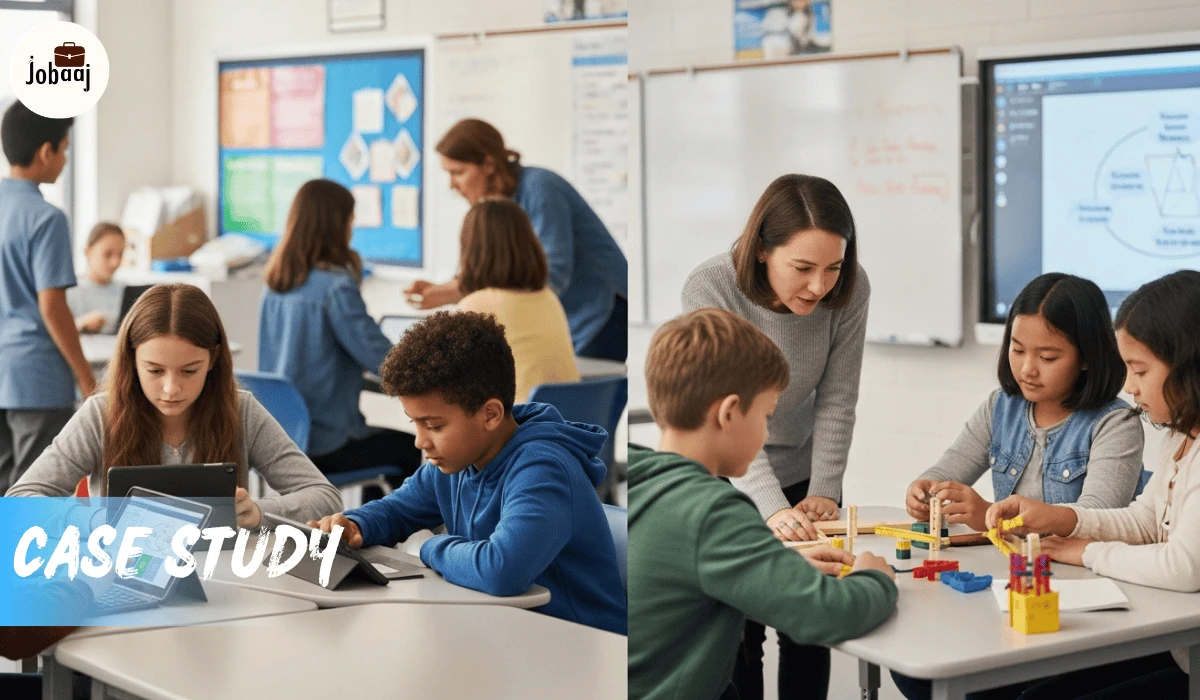
A classroom where traditional chalk-and-board lessons blend seamlessly with interactive digital experiences. Students are no longer just passive listeners but active participants in their education. This is the world of blended learning a hybrid approach that combines online digital media with conventional classroom teaching.
Over the last decade, educators around the world have been exploring blended learning as a way to enhance student engagement, personalize learning experiences, and bridge gaps caused by diverse learning styles. With emerging technologies, schools have begun shifting from one-size-fits-all education toward adaptive and student-centered models.
This case study examines how blended learning transformed instruction and learning outcomes in K-12 schools. It dives into the challenges schools faced before adopting this model, how they implemented changes, what improvements they observed, and the lasting impact on students, teachers, and the broader learning community.
Background
Blended learning isn’t completely new. Before the digital era, teachers experimented with textbooks, workbooks, and individualized assignments. But the rise of digital tools, cloud-based learning platforms, and accessible connectivity gave blended learning a practical, scalable shape.
In traditional classrooms, teachers played the central role in content delivery. However, as student needs became increasingly diverse, educators realized that students learn at different paces, have different interests, and require varied engagement methods.
Blended learning emerged as a solution that could combine the best of both worlds structured teacher-led instruction and flexible digital experiences.
Problem
Before the adoption of blended learning, many K-12 schools faced common challenges:
-
One-size-fits-all teaching: Traditional instruction often failed to cater to students with varying learning speeds.
-
Limited student engagement: A heavy focus on lecture-based teaching led to passive learning and reduced motivation.
-
Inconsistent performance: Students who struggled to keep up often fell even further behind, while advanced learners were held back by rigid pacing.
-
Heavy teacher workload: Teachers spent substantial time preparing materials and conducting repetitive assessments manually.
-
Limited use of technology: Most classrooms lacked meaningful integration of educational technology beyond basic computer labs or occasional digital activities.
These challenges were not unique to one school or district they were systemic issues affecting academic outcomes across regions.
Solution
To address these challenges, educators and administrators introduced a structured blended learning model in several K-12 schools using a phased and thoughtful approach:
1. Teacher Training and Professional Development
Teachers participated in workshops and training sessions focused on:
-
Using digital learning platforms (like Google Classroom, Khan Academy, Edmodo, and Schoology).
-
Integrating multimedia resources into lesson plans.
-
Leveraging learning analytics to track student progress.
Initial hesitation turned into confidence as teachers gradually mastered the tools and understood how technology could enhance, not replace, their classroom guidance.
2. Customized Learning Paths
Instead of teaching the entire class at the same pace, schools started:
-
Assigning online modules tailored to individual learning needs.
-
Allowing students to access lessons and practice exercises at their own pace.
-
Providing differentiated tasks easier modules for struggling learners, and extension challenges for advanced students.
This flexibility ensured no student was left behind or held back.
3. Flipped Classroom Techniques
Teachers flipped traditional classroom routines by asking students to:
-
Review lessons and video explanations at home through digital platforms.
-
Use classroom time for discussion, interactive problem solving, and collaborative activities.
This flipped model helped move passive learning outside the classroom and active learning inside it.
4. Real-Time Feedback and Data Evaluation
Learning platforms provided instant feedback to students and teachers. This allowed:
-
Students to correct mistakes immediately.
-
Teachers to identify learning gaps and adjust instruction in real time.
This data-driven feedback loop became a powerful tool for targeted intervention.
Findings
After implementing blended learning over an academic year, schools recorded significant qualitative and quantitative changes:
1. Increased Student Engagement
Students reported higher interest and participation during lessons, especially when they could interact with multimedia content and gamified activities.
One student remarked,
“Learning felt more like exploration than just answering questions in a notebook.”
2. Improved Academic Performance
Standardized test results showed noticeable improvements, particularly in subjects like mathematics and science, where adaptive digital exercises helped reinforce concepts.
Schools observed up to 20-30% increase in average performance for students who actively engaged with blended tools.
3. Enhanced Teacher Effectiveness
Teachers found that digital tools freed up valuable class time. Rather than spending hours grading worksheets, teachers could focus on mentoring, group activities, and remediation for students who needed extra support.
4. Better Learning Retention
Students demonstrated higher memory retention when lessons were delivered in blended formats visual, auditory, and hands-on digital interactions reinforced concepts more effectively than textbook-only study.
Results
By the end of the evaluation period, the impact of blended learning was clear:
| Parameter | Before Blended Learning | After Blended Learning |
| Student Engagement | Moderate | High |
| Academic Scores | Average, inconsistent | Improved consistently |
| Teacher Workload | High | Reduced with more focus on core instruction |
| Student Confidence | Low to medium | High |
| Classroom Interaction | Teacher-centered | Interactive & student-centered |
Educational leaders also reported:
-
More collaboration among students.
-
Higher satisfaction in classroom participation.
-
Greater parental involvement, as students accessed online resources from home.
Challenges Faced During Implementation
The transition was not without hurdles:
-
Infrastructure Limitations – Some schools initially struggled with internet access and device shortages.
-
Resistance to Change – A few teachers were hesitant to adopt new technology due to lack of familiarity.
-
Training Time – Professional development required time and resources before yielding results.
-
Balancing Screen Time – Ensuring students did not get overwhelmed by excessive screen time was crucial.
However, these challenges were steadily resolved with planning, investment, and continuous support.
Conclusion
The case of blended learning in K-12 education reveals a powerful lesson: when technology is thoughtfully integrated with traditional teaching, student learning becomes more adaptive, engaging, and effective.
Blended learning didn’t replace teachers it empowered them. It didn’t remove textbooks it made their use more meaningful. Most importantly, it gave students the freedom to learn at their own pace, deepened their understanding, and reinforced their confidence.
As schools continue to embrace digital transformation, blended learning stands out as a promising approach that not only prepares students for exams but equips them with the skills they need for life beyond the classroom.
FAQs
Blended learning combines traditional classroom teaching with digital tools and online resources to create a flexible learning environment that adapts to student needs.
It enhances student engagement, supports differentiated instruction, and allows for personalized learning and real-time feedback, improving overall learning outcomes.
By training teachers, using adaptive learning platforms, incorporating flipped classroom techniques, and regularly monitoring student progress using data analytics.
Challenges include infrastructure limitations, resistance to change, training needs, and managing screen time, but these can be overcome with planning and support.
Yes, schools that adopted blended learning reported improved test scores and better retention of concepts, especially in subjects requiring practice and reinforcement.
Blended learning benefits students with different learning styles by offering multiple ways to access and interact with content, making learning more inclusive.