Artificial intelligence is no longer just a technology used by researchers and engineers. It is becoming a part of everyday work across industries.
A new category of careers is emerging where professionals do not simply use AI as a supporting tool. They build their workflows, decision-making processes and products around AI from the beginning.
These careers are known as AI-native careers. Unlike traditional roles where technology helps complete tasks, AI-native professionals work alongside intelligent systems to create faster, smarter and more personalised solutions.
A marketer using AI to analyse customer behaviour, a product manager designing AI-powered features or a designer creating human-friendly AI experiences are examples of professionals working in AI-native roles.
The future of work will not only belong to people who understand AI technology. It will belong to people who know how to apply AI to solve real-world problems.
What Makes a Career AI-Native?
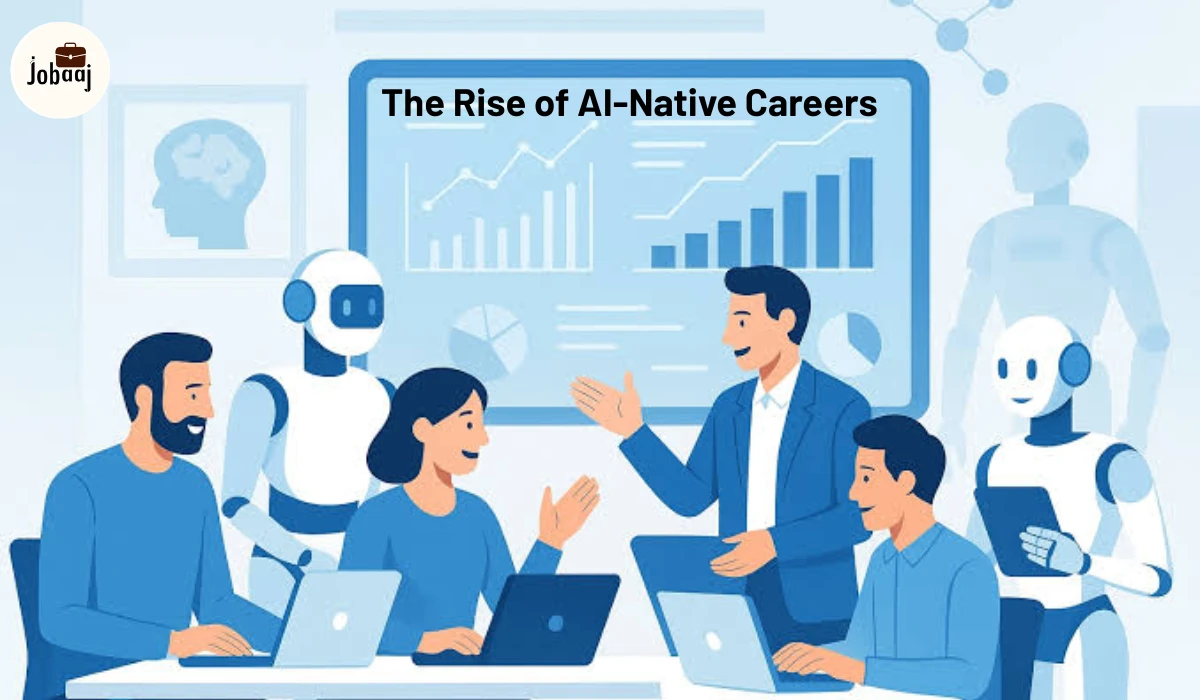
An AI-native career is built around collaboration between humans and artificial intelligence.
The professional is not replaced by AI. Instead, AI becomes an extension of their skills.
For example, a traditional business analyst may manually prepare reports from company data. An AI-native analyst can create automated systems that identify trends, generate insights and support faster decision-making.
Similarly, a traditional software developer writes code manually, while an AI-enabled developer uses AI assistants to improve productivity, test applications and solve technical challenges faster.
The biggest change is moving from simply completing tasks to designing intelligent workflows.
Why AI-Native Careers Are Growing
Companies across industries are investing heavily in artificial intelligence because AI can improve efficiency, reduce repetitive work and create better customer experiences.
Businesses are moving beyond AI experiments and starting to integrate AI into their daily operations.
This shift is creating demand for professionals who can understand both technology and business needs.
Industries adopting AI rapidly include:
- Healthcare
- Finance
- Marketing
- Education
- Manufacturing
- Retail
- Software development
The important point is that AI careers are not limited to computer science graduates. Professionals from different backgrounds can build AI-focused careers by combining AI knowledge with their existing expertise.
Emerging AI-Native Career Opportunities
AI Product Manager
AI Product Managers are responsible for creating products where artificial intelligence plays a central role.
They decide what AI features should be built, understand user problems and work with engineering teams to deliver useful solutions.
For example, an AI Product Manager working on a banking application may decide how AI can improve fraud detection, customer support or personalised recommendations.
This role requires a combination of product thinking, customer understanding, business strategy and AI awareness.
Important skills include:
- Product management
- User research
- Data understanding
- AI fundamentals
- Communication
AI Product Management is becoming one of the most promising career paths because almost every industry is creating AI-powered products.
AI Automation Specialist
Many companies want to use AI to improve internal processes.
AI Automation Specialists identify repetitive business tasks and create AI-based workflows to make operations faster.
Their work may involve automating customer support, document processing, reporting systems or administrative tasks.
This role is suitable for people who enjoy improving processes and finding practical uses for technology.
Key skills include understanding:
- AI tools
- Automation platforms
- Business workflows
- Basic APIs
- Process improvement
AI Engineer and Machine Learning Specialist
AI Engineers build the systems behind artificial intelligence applications.
They develop and improve machine learning models, recommendation systems, AI assistants and intelligent software solutions.
This is one of the more technical AI career paths.
Professionals usually need knowledge of:
- Python programming
- Machine learning
- Statistics
- Deep learning
- Data structures
AI Engineers are especially important in industries building advanced AI products.
AI UX Designer
Artificial intelligence has changed how people interact with digital products.
AI UX Designers focus on creating experiences where humans can communicate naturally with AI systems.
Their work includes designing:
- AI assistants
- Chat interfaces
- AI-powered applications
- User interaction flows
The challenge is not only making AI powerful but making it simple, trustworthy and easy for users.
This career combines traditional UX design skills with an understanding of AI behaviour.
AI Data Specialist
AI systems depend heavily on high-quality data.
AI Data Specialists help prepare and manage the information required for AI models.
They work on improving data quality, organising datasets and supporting AI development.
This role is important because even the most advanced AI systems depend on accurate and reliable data.
Skills that help in this career include:
- Data analysis
- SQL
- Data management
- Basic Python
- Quality checking
AI Governance Specialist
As companies use AI for important decisions, responsible AI management is becoming necessary.
AI Governance Specialists help organisations create safe and ethical AI systems.
They focus on areas such as:
- AI policies
- Data privacy
- Risk management
- Compliance
- Responsible AI practices
This field will become increasingly important as governments and companies establish AI regulations.
Skills Required for AI-Native Careers
AI Literacy
Understanding AI does not mean everyone needs to become an AI researcher.
Professionals need to understand what AI can do, where it performs well and where human judgement is still required.
AI literacy includes knowing how to select the right tools, write effective instructions and evaluate AI-generated results.
Problem-Solving Ability
AI is powerful, but it does not decide which problems are worth solving.
Professionals who can identify business challenges and apply AI effectively will have a major advantage.
The value will come from asking the right questions, not just using the latest AI tools.
Domain Knowledge
AI becomes more valuable when combined with industry expertise.
For example:
- A finance professional who understands AI can build better financial automation solutions.
- A healthcare professional with AI knowledge can help create better medical technology.
- A designer who understands AI can create better user experiences.
The future will favour professionals who combine AI with another strong skill.
Communication Skills
AI professionals need to explain ideas clearly.
They often work with people from different backgrounds, including business leaders, developers, designers and customers.
Being able to explain AI benefits, limitations and risks is becoming an important career skill.
How Students Can Prepare for AI-Native Careers
The best way to prepare is not to learn AI in isolation.
Students should combine AI with a practical career skill.
For example:
- Marketing + AI tools
- Data Analytics + AI automation
- Product Management + AI products
- Design + AI experiences
- Finance + AI solutions
Start by using AI tools in real projects.
Create examples where AI helps solve a problem, improves efficiency or creates a better user experience.
A portfolio showing practical AI application can be more valuable than simply completing AI courses.
Will AI Replace Traditional Careers?
AI will change many careers, but it is unlikely to remove the need for human expertise completely.
The nature of work will evolve.
A designer will become an AI-assisted designer.
A developer will become an AI-powered developer.
A marketer will become an AI-driven marketer.
The advantage will go to professionals who learn how to work with AI rather than those who ignore it.
Future Scope of AI-Native Careers
AI-native careers are expected to expand as companies continue integrating artificial intelligence into products and operations.
Future opportunities will grow in:
- AI product development
- AI automation
- AI consulting
- AI security
- AI governance
- Human-AI interaction design
The biggest opportunities will not only come from building AI models. They will come from people who understand how to apply AI effectively in different industries.
Conclusion
The rise of AI-native careers represents one of the biggest changes in the modern workplace.
AI is creating a new generation of professionals who combine human creativity, industry knowledge and artificial intelligence.
Students who start learning AI today do not need to become AI researchers. They need to understand how AI can improve the way people work, solve problems and create value.
The future will belong to professionals who can combine their expertise with AI and use technology as a partner for innovation.
FAQs
AI-native careers are roles where artificial intelligence is a central part of daily work. Professionals in these careers use AI systems to improve decision-making, automate processes, create products and solve problems instead of using AI only as an occasional tool.
Beginners can explore AI-related careers such as AI automation specialist, AI product associate, AI content strategist, data specialist or AI operations roles. The best choice depends on existing skills and interests. Combining AI knowledge with another professional skill often creates stronger opportunities.
Some AI careers, such as machine learning engineering, require programming knowledge. However, many AI-related roles like AI product management, AI strategy and automation do not require advanced coding but need problem-solving and AI understanding.
Students can start by learning AI tools, understanding basic AI concepts and building practical projects. Combining AI with fields like marketing, finance, design, analytics or product management can help create stronger career opportunities.