The world of technology is evolving at lightning speed. What was cutting-edge a few years ago may already be considered outdated today. In 2026, technological advancements are reshaping industries, revolutionizing how we live, work, and communicate. From artificial intelligence to quantum computing, the possibilities are limitless.
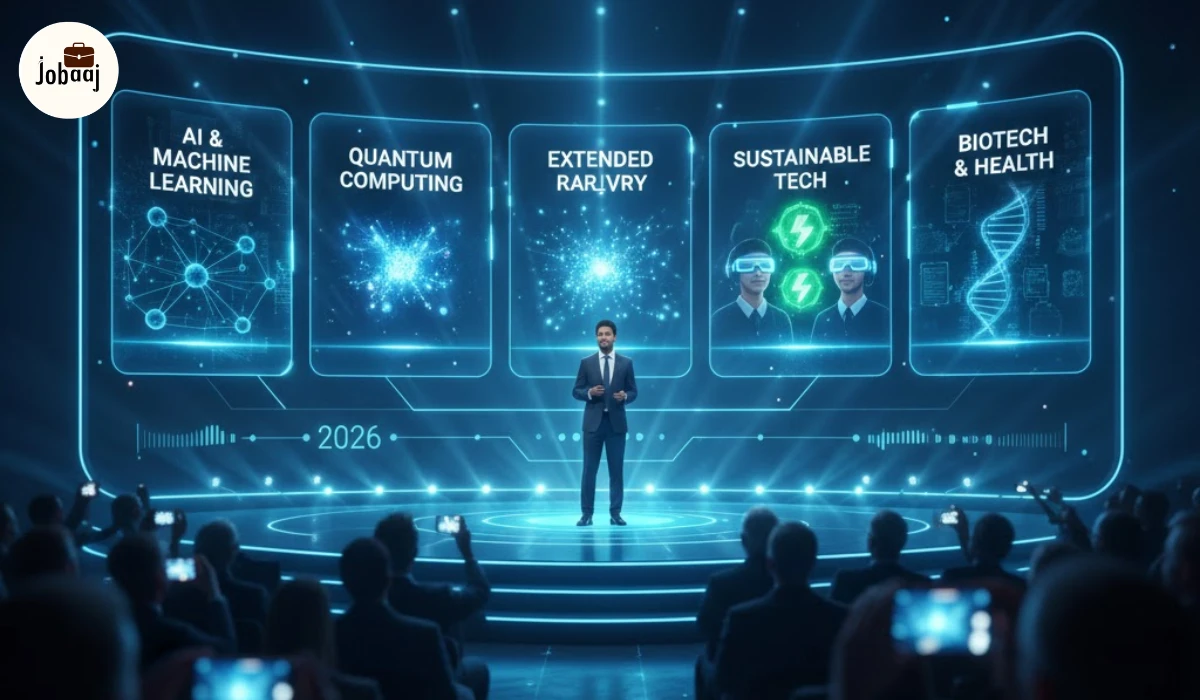
As technology continues to drive change across all sectors, it’s crucial to stay informed about the latest trends that are capturing attention worldwide. In this blog, we’ll explore the top 5 tech trends that everyone is talking about in 2026. These trends are not just buzzwords; they represent fundamental shifts that are poised to impact businesses, consumers, and the global economy in profound ways.
1. Artificial Intelligence (AI) and Machine Learning (ML)
Artificial Intelligence (AI) and Machine Learning (ML) have long been transformative technologies, but by 2026, their capabilities have reached new heights. AI has evolved from being a tool for automation to an essential driver of innovation, creating smarter systems, enhancing customer experiences, and solving complex business challenges.
AI and ML are now embedded in everything from self-driving cars to personalized recommendations in e-commerce. They are also playing a crucial role in healthcare, where AI-powered systems are helping doctors diagnose diseases with unprecedented accuracy. AI has even begun to shape creative industries, where algorithms are creating artwork, music, and even writing.
In 2026, AI and ML have become the backbone of many industries. AI-driven solutions are helping businesses improve decision-making, streamline operations, and predict future trends. Companies that harness the power of AI will gain a significant competitive edge in data-driven markets.
Key Areas of AI and ML Impact in 2026:
-
Healthcare: AI models are diagnosing diseases early and personalizing treatment plans.
-
Finance: AI is optimizing trading strategies, fraud detection, and customer service in the finance sector.
-
Retail and E-commerce: Personalization engines are enhancing customer experiences and boosting sales.
-
Automation: AI is increasingly responsible for automating complex tasks in manufacturing, logistics, and even legal services.
2. Quantum Computing
Quantum computing is one of the most talked-about tech trends in 2026, and it’s poised to revolutionize industries. Unlike classical computers, which process information in binary bits, quantum computers use quantum bits (qubits) that can represent multiple states simultaneously. This ability allows quantum computers to solve problems that would take traditional computers millennia to figure out in just a fraction of the time.
While quantum computing is still in its early stages, breakthroughs in quantum hardware and algorithms are expected to have significant impacts in fields like cryptography, drug discovery, and artificial intelligence. Researchers are working tirelessly to unlock the full potential of quantum computers, and in 2026, we’re starting to see the first real-world applications emerge.
Quantum computing could provide the breakthrough needed for solving complex problems that currently overwhelm classical computers. Its potential to disrupt fields like cryptography, cybersecurity, and AI makes it a key trend to watch. Major tech companies like IBM, Google, and Microsoft are investing heavily in quantum computing research, and by 2026, its applications are becoming more tangible.
Key Areas of Quantum Computing Impact in 2026:
-
Cryptography and Cybersecurity: Quantum computing can crack encryption codes, leading to both new challenges and opportunities for cybersecurity.
-
Drug Discovery: Quantum computers have the potential to simulate molecular structures and revolutionize pharmaceutical development.
-
Material Science: Quantum computing can help scientists design new materials with specific properties for industries like electronics and energy storage.
3. 5G and Beyond (6G)
The rollout of 5G networks has already begun to reshape how we connect to the internet, but by 2026, the full power of 5G will be realized. With 5G, users can expect faster speeds, lower latency, and more reliable connections, allowing for new innovations like autonomous vehicles, smart cities, and IoT (Internet of Things) applications to flourish.
Looking even further ahead, 6G technology is already being researched and discussed. 6G promises even faster speeds, greater bandwidth, and the ability to support billions of connected devices simultaneously. This will be crucial as industries continue to embrace the Internet of Everything (IoE), where all devices both digital and physical are interconnected.
5G will enable innovations that were once thought to be impossible, such as ultra-low latency applications and advanced augmented reality experiences. By 2026, it will be the foundation for smart homes, IoT devices, and immersive digital experiences.
Key Areas of 5G and 6G Impact in 2026:
-
Autonomous Vehicles: With ultra-fast communication speeds, 5G allows vehicles to communicate with each other and traffic systems in real time, making self-driving cars safer and more efficient.
-
Smart Cities: 5G supports connected infrastructure, enabling cities to optimize energy use, traffic flow, and public services.
-
IoT (Internet of Things): 5G will empower an explosion of IoT devices, creating smarter homes, workplaces, and factories.
-
Virtual and Augmented Reality: With 5G, real-time VR and AR experiences will be seamless and interactive, revolutionizing gaming, education, and healthcare.
4. Blockchain Technology and Decentralized Finance (DeFi)
Blockchain technology has gone beyond its original use in cryptocurrencies like Bitcoin. By 2026, blockchain is being adopted across industries for its ability to securely store data, verify transactions, and eliminate the need for intermediaries. Decentralized Finance (DeFi) is a prominent area where blockchain is making waves. DeFi allows individuals to engage in financial transactions without traditional banks or financial institutions, opening up financial services to a global audience.
Blockchain’s ability to provide transparency, security, and decentralization is reshaping industries like finance, supply chain management, and even healthcare. In 2026, DeFi is expected to continue its growth, providing opportunities for financial inclusion and new ways of managing wealth.
Key Areas of Blockchain Impact in 2026:
-
Decentralized Finance (DeFi): Blockchain enables peer-to-peer financial services without the need for banks, lowering costs and increasing accessibility.
-
Supply Chain Transparency: Blockchain helps track the movement of goods in supply chains, reducing fraud and improving traceability.
-
Smart Contracts: Blockchain’s ability to automate contract execution is revolutionizing industries like real estate, insurance, and legal services.
5. Artificial Reality (AR) and Virtual Reality (VR)
Augmented Reality (AR) and Virtual Reality (VR) technologies are set to become mainstream in 2026. These immersive technologies are no longer limited to gaming or entertainment; they are transforming fields such as healthcare, education, retail, and real estate.
Augmented Reality (AR) enhances the real world by overlaying digital information on physical objects, creating interactive experiences for users.
Virtual Reality (VR) immerses users in a completely virtual environment, making it an excellent tool for training, simulation, and gaming.
AR and VR are expected to revolutionize how people interact with digital content and the physical world. In industries like healthcare, VR is being used for surgical training and patient care, while AR is enhancing retail experiences by allowing customers to visualize products in their own homes before purchase.
Key Areas of AR and VR Impact in 2026:
-
Healthcare: VR is used for training doctors and performing remote surgeries, while AR aids in patient diagnosis and therapy.
-
Retail: AR enhances the shopping experience, allowing customers to virtually try products before buying.
-
Education: VR offers immersive learning experiences, making education more engaging and interactive.
-
Gaming: Both AR and VR are transforming the gaming industry, creating fully immersive environments for players.
Conclusion
As we move through 2026, these five tech trends AI, quantum computing, 5G, blockchain, and AR/VR are shaping the future of industries worldwide. Embracing these technologies will not only drive innovation but also create new business opportunities and careers. Whether you are a developer, entrepreneur, or someone simply interested in the future of technology, these trends offer endless possibilities.
By staying informed about these cutting-edge technologies, you can position yourself to thrive in a rapidly evolving digital landscape. The future is here, and it’s powered by these exciting innovations. Make sure to stay ahead by learning, adapting, and preparing for what comes next!
FAQs
The top tech trends in 2026 include Artificial Intelligence (AI), Quantum Computing, 5G and Beyond, Blockchain, and Augmented Reality (AR) & Virtual Reality (VR). These technologies are expected to shape industries worldwide and drive innovation.
AI will continue to drive business innovation by enhancing automation, improving data analysis, and delivering personalized customer experiences across industries like healthcare, finance, and retail.
Quantum computing uses quantum bits (qubits) to solve complex problems that traditional computers cannot. By 2026, quantum computing is expected to revolutionize areas like cryptography, drug discovery, and AI.
5G will enable faster internet speeds, more reliable connections, and support billions of devices, transforming industries such as autonomous vehicles, smart cities, and IoT.
AR and VR will revolutionize industries like healthcare, education, retail, and entertainment, enhancing user experiences through immersive technology.