
The job market in India is evolving rapidly, shaped by technological advancements, shifting work dynamics, and a growing demand for skilled professionals. In 2025, the landscape will continue to be influenced by AI, remote work, and sector-specific demands. Whether you're looking to advance in your current role or exploring new opportunities, understanding the key trends will give you the edge you need to succeed. In this blog, we’ll dive into the major hiring trends, sector-specific growth, and insights on salary benchmarks, hiring across cities, and more.
Job Market Growth in India
India's job market is expanding as companies adopt new technologies, focus on skill-based hiring, and cater to evolving industry demands. The country’s job market is predicted to grow significantly in 2025, driven by sectors like IT, healthcare, finance, and e-commerce. With the rise of automation and AI, businesses are hiring talent that can support their digital transformation efforts.
As businesses recover and grow, there is an increasing need for skilled workers to fill both traditional roles and new ones, such as data scientists, AI specialists, and cybersecurity experts. In the coming years, job seekers will find opportunities not only in the well-established industries but also in emerging sectors like green jobs and sustainability roles.
In particular, India's Tier-1 cities, such as Delhi, Mumbai, Bengaluru, and Hyderabad, are seeing a surge in job opportunities, as companies focus on urban centers for talent acquisition. However, with the rise of remote work, opportunities are also spreading to Tier-2 and Tier-3 cities, allowing professionals from across the country to participate in the growing job market.
Looking for Jobs: Apply here
High-Demand Skill Categories
The demand for skilled professionals in India has shifted from traditional qualifications to specialized skill sets. In 2025, the following categories will be in high demand:
Artificial Intelligence (AI) and Machine Learning (ML): Companies are increasingly looking for AI/ML specialists to help them develop new solutions, automate processes, and analyze big data.
Data Science and Analytics : Data science and analytics are at the heart of decision-making in today’s business environment. Companies across sectors are looking for data scientists, analysts, and statisticians who can derive actionable insights from complex datasets.
Investment Banking: Investment banking roles continue to be highly sought after for professionals skilled in financial analysis, mergers & acquisitions (M&A), and capital market strategies.
Full Stack Developers: Full stack developers who can handle both front-end and back-end development are essential for creating seamless, end-to-end solutions for digital platforms.
Management Consulting: Professionals in management consulting are sought after for their expertise in advising businesses on strategic decisions, operational improvements, and managing change. They help companies optimize processes, improve performance, and navigate complex business challenges.
Cybersecurity and Data Privacy: As cyber threats become more prevalent, cybersecurity experts will be highly sought after to protect companies’ sensitive data and infrastructure.
Cloud Computing and DevOps: With the rise of cloud technologies, there’s a growing need for professionals who can manage cloud infrastructure and help businesses scale efficiently.
Product Management: Product managers are in demand to lead product development, ensuring new products meet market demands and business objectives while coordinating cross-functional teams.
Digital Marketing and Social Media Expertise: As businesses shift to online platforms, digital marketers skilled in SEO, SEM, content marketing, and social media management will be in demand.
For job seekers, focusing on developing skills in these areas will not only open up opportunities in high-growth industries but also make them competitive in a job market that values expertise over traditional qualifications.
Quarterly Hiring Trends in India
Hiring in India follows a predictable seasonal pattern, with some quarters experiencing higher recruitment activity than others. Understanding this pattern is crucial for job seekers to time their applications effectively, and for employers to plan their hiring strategies.
Q1 (April - June): Moderate Hiring
Hiring Activity Level: Slow(20-25%)
Why Hiring Remains Moderate:
-
Companies continue to fill positions left open from Q4.
-
Campus recruitment for fresh graduates, especially in IT, consulting, and finance.
-
Expansion of projects approved in Q4, requiring additional talent.
Real Numbers:
-
60% of employers are actively hiring.
-
Around 20-25% of annual hiring happens in Q1.
Best For:
-
Fresh graduates, entry-level candidates, and mid-level professionals looking for growth.
Q2 (July - September): Slower Hiring Period
Hiring Activity Level: Moderate(25-30%)
Why Hiring Slows:
-
Companies focus on mid-year performance reviews rather than aggressive expansion.
-
The monsoon and vacation periods affect certain industries.
-
Companies prepare for the upcoming festive season, reducing recruitment.
Real Numbers:
-
Hiring activity drops by 30-40% compared to Q1 and Q4.
-
Approximately 25-30% of annual hiring happens in Q2.
Best For:
-
Senior professionals and those with specialized skills (e.g., AI/ML, cybersecurity).
Q3 (October - December): Good Hiring Activity
Hiring Activity Level: Moderate to High (35-40%)
Why Hiring Picks Up:
-
Companies push to meet year-end hiring targets.
-
Retail, logistics, and e-commerce sectors experience a surge due to festive season demands.
-
Companies prepare for Q4 by hiring in December to ensure teams are ready.
Real Numbers:
-
Net Employment Outlook reaches 37-40%.
-
Around 25% of annual hiring occurs in Q3.
Best For:
-
Retail, logistics, e-commerce professionals, and anyone looking to start fresh in January.
Q4 (January - March): High Hiring Activity
Hiring Activity Level: Highest (50-55%)
Why it’s the Peak Quarter:
-
Annual budgets are finalized, and companies have the financial backing to hire.
-
New fiscal year planning kicks off, leading to new project hires.
-
Fresh openings are created as companies aim to start the year strong.
Real Numbers:
-
70-75% of employers are actively hiring.
-
50-55% of annual hiring happens in Q4.
Best For:
-
Job seekers at all experience levels, especially those looking for leadership roles, fresh graduates, and professionals seeking maximum opportunities and better compensation.
| Quarter | Period | % of Employers Hiring | % of Annual Hiring Volume | Key Characteristic |
| Q1 | Apr - Jun | 20-25% | 15-20% | Campus recruitment, strong momentum |
| Q2 | Jul - Sep | 25-30% | 20-25% | Strategic hiring, specialized roles only |
| Q3 | Oct - Dec | 35-40% | 25-30% | Year-end push, festive hiring surge |
| Q4 | Jan- Mar | 50-55% | 35-40% | Peak hiring season - NEW roles created |
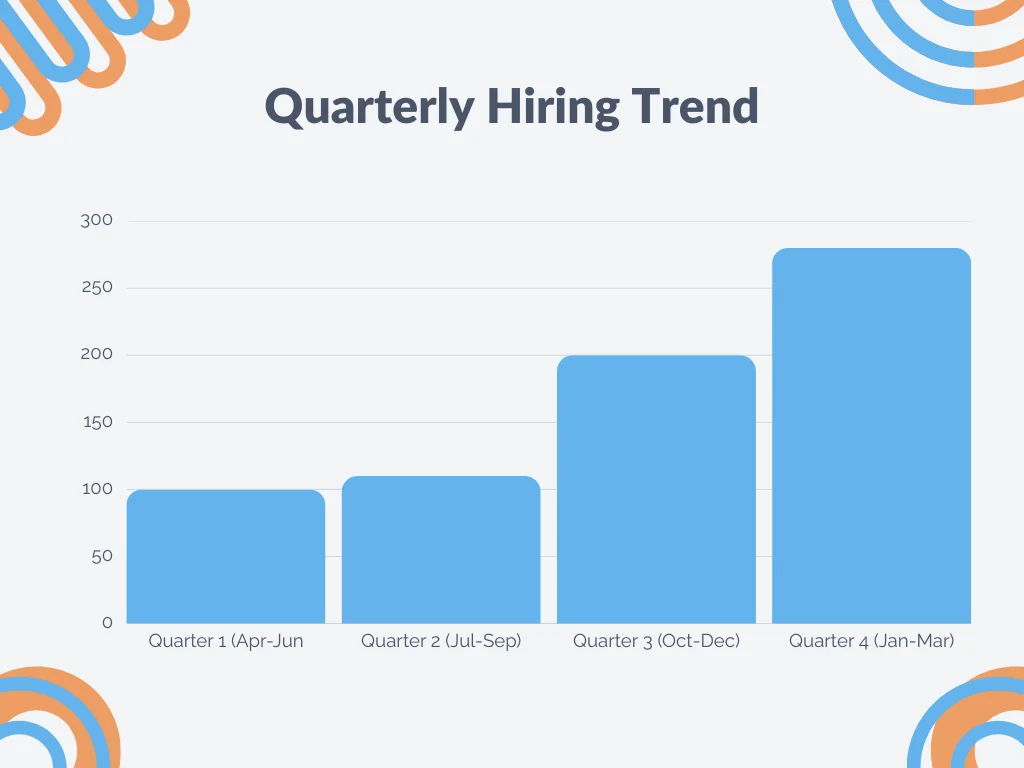
Q4 (January-March) consistently shows the highest hiring activity as companies finalize their annual budgets and launch new initiatives for the fiscal year. This makes it the best time for job seekers to explore opportunities.
Hiring Trends Across Cities
India's job market is experiencing different hiring dynamics across its cities. While Tier-1 cities have always been the hub of employment, the rise of remote work has allowed Tier-2 and Tier-3 cities to catch up.
Bengaluru, Delhi, and Mumbai continue to dominate the hiring scene, particularly in tech, finance, and corporate sectors. Bengaluru remains the country’s IT capital, while Delhi and Mumbai offer opportunities in banking, marketing, and consultancy.
Hyderabad and Pune are emerging as strong contenders, especially in the IT and education sectors. These cities are attracting both national and international companies, offering a growing number of opportunities in tech, manufacturing, and e-commerce.
Smaller cities like Ahmedabad, Lucknow, and Jaipur are also seeing an increase in hiring. Companies are starting to recognize the potential of hiring talent from these regions, especially for remote roles and positions in sectors like customer service, education, and healthcare.
As a job seeker, it’s important to consider not only the well-established job hubs but also the growing opportunities in smaller cities where the cost of living is lower and the competition may be less intense.
Salary Benchmarks for 2025
As companies compete for top talent, salary benchmarks are expected to rise across most industries in 2025. However, salary levels will vary depending on the industry, location, and experience level.
IT and Technology: Salaries for professionals in AI, data science, cybersecurity, and cloud computing are expected to be among the highest, with average annual salaries ranging from 8,00,000 to 20,00,000 depending on experience.
Finance and Banking: Professionals in finance, investment banking, and financial consulting can expect competitive salaries, ranging from 6,00,000 to 15,00,000 annually.
Healthcare: Doctors, healthcare managers, and specialists will see salaries in the range of 5,00,000 to 12,00,000 per year.
Marketing and Sales: Digital marketers and sales managers in e-commerce and FMCG companies can expect salaries between 5,00,000 and 10,00,000 annually, with potential bonuses and commissions.
Green and Sustainability Jobs: Roles in renewable energy and sustainability are expected to offer salaries ranging from 6,00,000 to 12,00,000 annually, depending on the company and level of expertise.
Salary expectations will continue to be a key factor for job seekers. It’s essential to keep track of industry-specific salary trends to ensure you're negotiating your compensation effectively.
Hiring Trends Across Experience Levels
The hiring trends in India are also influenced by the level of experience candidates bring to the table. Here’s a breakdown:
Entry-Level Positions (0-3 years): For freshers, hiring is expected to be strong, particularly in tech, marketing, sales, and customer service. While salary levels may not be as high, there will be ample opportunities for skill development, internships, and entry-level roles. Many companies offer graduate programs to attract young talent.
Mid-Level Positions (3-7 years): Professionals with 3-7 years of experience will see increased demand, especially in roles such as project managers, software developers, data analysts, and financial analysts. This experience level offers a blend of expertise and hands-on skills, making candidates highly sought after.
Senior-Level Positions (7+ years): Senior professionals in leadership roles, such as CTOs, CFOs, and VPs, will continue to be in high demand. Salaries at this level are the highest, but companies will require extensive experience and a proven track record of success.
For job seekers, it's crucial to tailor your job search based on your experience level and focus on roles that align with your expertise. Upskilling and certifications can also help accelerate your career progression.
Conclusion:
In 2025, India’s job market will be shaped by technological innovations, evolving hiring practices, and sector-specific demands. By focusing on high-demand skills, staying updated on salary benchmarks, and timing your job search for peak hiring periods (especially Q4), you’ll be well-positioned to take advantage of the opportunities in this dynamic market.
Job seekers in India will find great prospects across multiple industries, but staying ahead will require continuous learning, adapting to new trends, and focusing on skill-based hiring. As you navigate through the year, keep an eye on the sectors, cities, and hiring periods that will provide the best chances to advance your career.
FAQs
Top sectors include IT, healthcare, e-commerce, finance, and green jobs, with significant demand in data science, cybersecurity, and sustainability roles.
AI is streamlining the recruitment process by automating resume screening, scheduling interviews, and assessing candidates’ skills, reducing bias, and increasing efficiency.
The best time to look for a job in India is during Q4 (January-March), when companies tend to hire the most as they plan their workforce for the year.
The gig economy is on the rise, with more professionals opting for freelance and contract work, especially in sectors like IT, marketing, and content creation.
Skill-based hiring focuses on a candidate's skills and abilities rather than formal qualifications or years of experience, which is especially important in tech and creative sectors.