
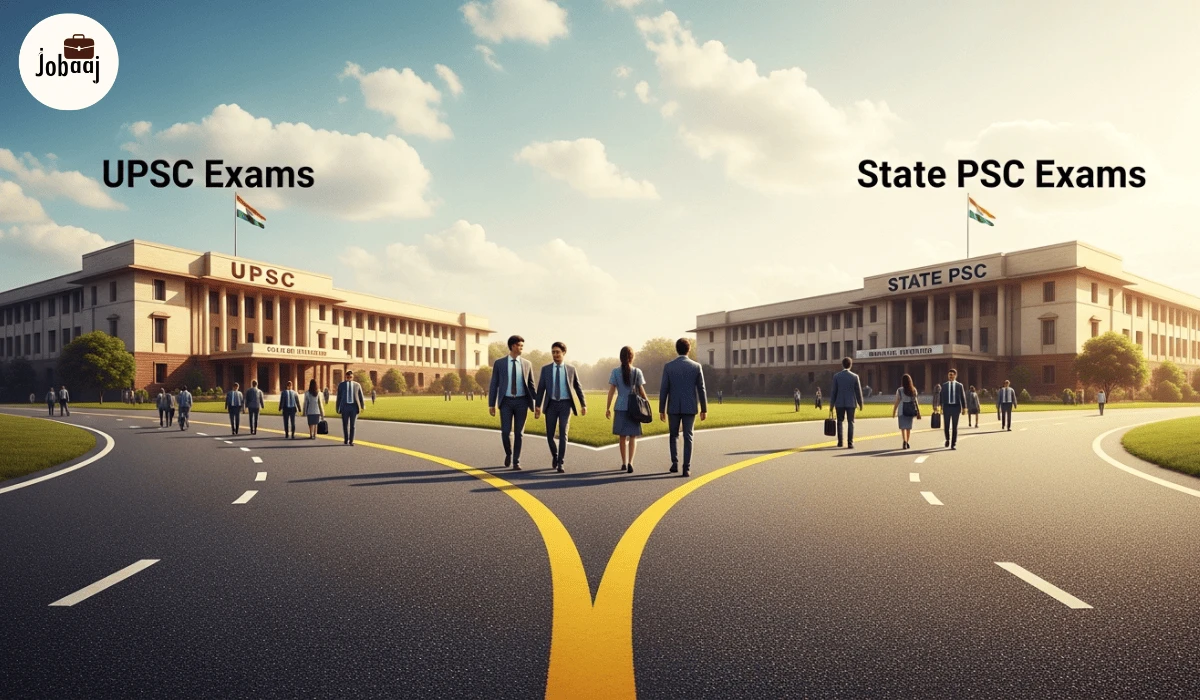
You’ve likely heard stories of those who’ve made it big in the civil services people with prestigious roles like IAS officers, IPS officers, or Indian Foreign Services officers. The idea of serving the nation in one of these capacities might have sparked something within you. But the journey to get there isn’t easy. The first big hurdle? Choosing between UPSC and State PSC exams.
If you’re serious about a career in the Indian civil services, this decision can shape your future. After all, both exams offer distinct opportunities. One gives you the chance to serve at the national level, while the other focuses on state-level administrative roles. The competition, lifestyle, and career progression paths differ as well.
In this blog, we’ll walk you through what each exam entails, the pros and cons of each, and the factors to consider when making your decision. Understanding what UPSC and State PSC exams bring to the table will help you make an informed choice that aligns with your career goals, personality, and lifestyle.
Scope and Level of Competition
When it comes to civil services exams, the competition plays a massive role in your preparation journey. You need to think about where you want to make an impact at the state level or national level.
-
UPSC: UPSC exams are the gateway to the top-tier roles in the country, like IAS, IPS, IFS, and other prestigious positions. These exams are highly competitive, with thousands of candidates from across the country vying for a limited number of seats. The stakes are higher, and the preparation process can be daunting.
-
State PSC: On the flip side, State PSC exams are generally more focused on the state-level administrative services. While the competition may not be as fierce as UPSC, it’s still competitive within your state. The roles you’ll be applying for such as State Civil Services, Revenue Officers, or Police Services are crucial for local governance but might not offer the same national exposure as the roles offered by UPSC.
Key Takeaway:
If you’re looking for prestige and want to be at the top of the administrative ladder, UPSC is your choice.
If you want to focus more on state-level issues, have a more manageable competition, and prefer working closer to home, State PSC might be the better fit.
Exam Structure and Syllabus
The syllabus and the exam structure play a huge role in shaping your preparation strategy.
-
UPSC: The UPSC syllabus is extensive and covers a wide range of subjects. From General Studies (which includes history, geography, economics, and current affairs) to optional subjects and even a personality test in the form of the interview. The UPSC exam is a multi-step process: Prelims, Mains, and finally, the Interview.
-
State PSC: While State PSC exams have a similar structure (Prelims, Mains, Interview), the syllabus is more localized. The focus is on the state’s issues, local governance, and knowledge of the state’s history, geography, and politics. This can make the preparation feel more focused and less overwhelming than the national-level UPSC exam.
Key Takeaway:
If you enjoy studying a broad array of topics and tackling complex national issues, the UPSC exam is likely a good fit.
If you prefer a more targeted, state-focused syllabus that’s more manageable and focused on your state’s governance, then State PSC might work better.
Career Opportunities and Postings
This is where the real difference comes in. Think about where you see yourself in the future and what kind of roles you’d like to pursue.
-
UPSC: Serving as an IAS officer, IPS officer, or IFS officer means you could be posted in any part of the country, or even abroad in the case of the IFS. The roles offer prestige, decision-making power, and impact at the highest levels of governance. However, these roles often come with high responsibilities and pressure.
-
State PSC: On the other hand, roles in the State PSC exams offer you the chance to serve within your own state. Positions like District Collector, Revenue Officer, or Deputy Superintendent of Police mean you’ll be closer to home, often working on local issues like land administration, public policy, and law enforcement. The work may be a little more predictable, but it also comes with less national influence compared to UPSC positions.
Key Takeaway:
If you want a prestigious national-level career, work in high-impact roles, and are willing to relocate frequently, UPSC is your best bet.
If you’re more interested in serving your state and focusing on local governance, State PSC offers great opportunities with less pressure and a predictable lifestyle.
Work-Life Balance
Consulting your own work-life balance expectations can help guide your decision.
-
UPSC: Working in IAS or IPS means a high-profile role, often with long hours and frequent relocations. Whether you’re managing a district as an IAS officer or tackling law and order as an IPS officer, the demands are intense. There are moments of stress and pressure, particularly during emergencies or crises.
-
State PSC: In contrast, State PSC jobs are generally less demanding in terms of working hours and pressure. While they do come with their own challenges, they tend to offer a more stable routine and predictable lifestyle. You’re likely to be working closer to home and engaged with more localized issues, which might offer a better work-life balance.
Key Takeaway:
If you want a dynamic, high-stakes role with a fast-paced, national-level impact, the UPSC path will fit.
If you prioritize a balanced lifestyle with more predictable work hours and prefer working on state-focused issues, the State PSC route may be better.
Preparation Time and Effort
The time commitment for preparation can vary drastically.
-
UPSC: Preparing for UPSC is a long-term commitment. Most candidates spend 1-2 years or even longer preparing for the exams. The process is exhaustive and requires a lot of dedication and consistency. From reading newspapers and current affairs to memorizing vast sections of textbooks, the preparation is demanding.
-
State PSC: While State PSC exams are also competitive and require solid preparation, the time commitment can be relatively shorter compared to UPSC. The syllabus is focused, and with less competition, you may need less time to prepare thoroughly.
Key Takeaway:
If you’re ready to dedicate 1-2 years or more to an exhaustive, national-level preparation, UPSC is the way to go.
If you’re looking for a more focused, less time-consuming preparation, State PSC might be a quicker route.
Which One Should You Choose
| Criteria | UPSC | State PSC |
| Scope | National-level services (IAS, IPS, IFS) | State-level services (e.g., District Collector, Revenue Officer) |
| Competition | High competition with candidates from across the country | Relatively lower competition within the state |
| Exam Structure | Prelims, Mains, Interview | Prelims, Mains, Interview |
| Syllabus | Extensive, includes national issues, current affairs, and optional subjects | Focused on state-related topics like state history, geography, and politics |
| Career Opportunities | High-profile roles with prestige (national impact, frequent relocation) | Focused on local governance and state-level issues (closer to home, more predictable) |
| Work-Life Balance | Often high-pressure roles, long hours, frequent relocations | More stable work hours and less pressure, work is more localized |
| Time Commitment | Requires 1-2 years or more for preparation | Typically requires less time due to a more focused syllabus |
| Postings | Can be posted anywhere in the country or abroad (e.g., IFS) | Primarily state-level postings, staying within your home state |
| Key Roles | IAS, IPS, IFS, IRS, IRTS, etc. | State Civil Services, Revenue Services, Police Services |
| Preparation Focus | Broad and in-depth across various subjects | State-focused, covering local governance and issues |
| Salary and Benefits | Higher salary and more perks at the national level | Salary and benefits can vary by state but generally offer stability |
Conclusion
Choosing between UPSC and State PSC exams depends largely on your personal career aspirations, lifestyle preferences, and ambitions. While the UPSC offers the prestige of national-level services and vast opportunities, it comes with high pressure and intense competition. On the other hand, the State PSC exams offer roles that are focused on state-level governance, providing you with stability, fewer competitors, and a more predictable work environment.
Ultimately, the right choice depends on whether you’re looking for national influence and a high-impact role or a more manageable, localized career with the opportunity to directly improve your state. By weighing these factors carefully, you’ll be able to make a decision that aligns with your long-term goals and personal values.
FAQs
The main difference lies in the level of service UPSC is for national-level services like IAS, IPS, and IFS, while State PSC exams focus on state-level services and administration.
UPSC exams are generally more competitive, with candidates from all over the country. State PSC exams have less competition since they are specific to individual states.
Preparing for UPSC generally takes 1-2 years or more, due to the vast syllabus and intense competition.
While both exams are challenging, State PSC exams have a more focused syllabus, and the competition is generally less intense compared to UPSC exams.
State PSC exams can lead to various roles within the state government, including administrative positions, revenue services, and police services, with opportunities for growth and leadership roles.
It can take several months to a few years to develop the necessary consulting skills. However, continuous learning and real-world experience will accelerate your growth in this field.