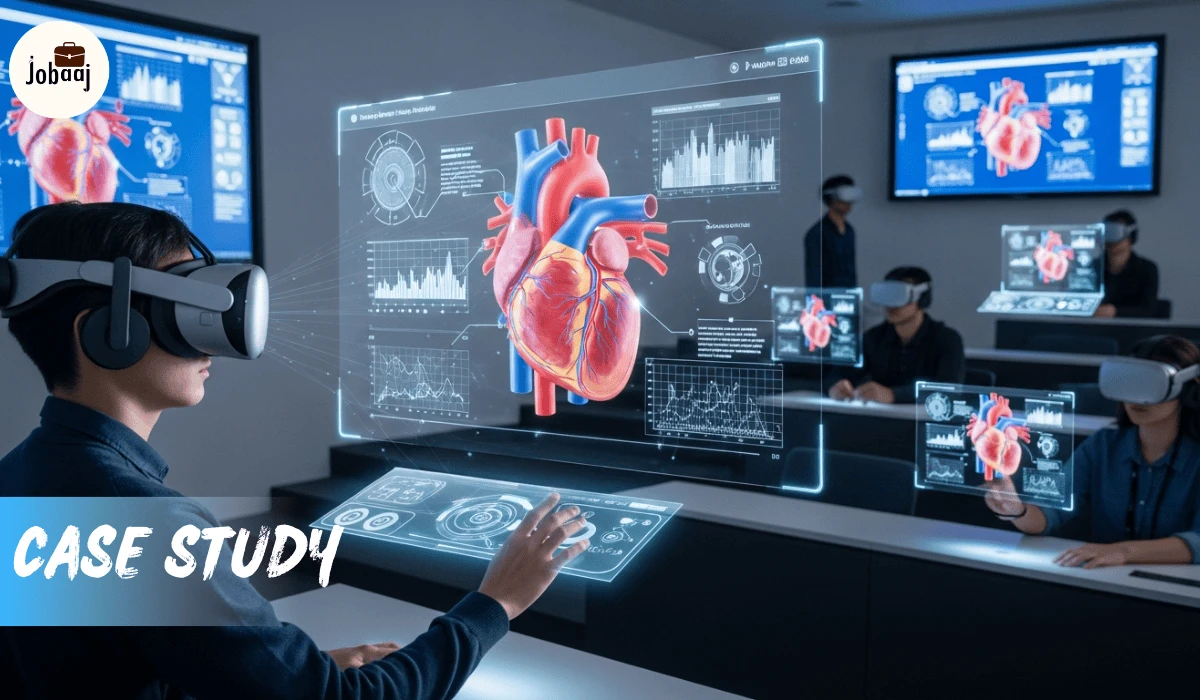
Stepping into your classroom and, instead of sitting at a desk, you put on a VR headset and are instantly transported to an ancient Greek amphitheater. You walk around the ruins, explore the historical architecture, and learn about the culture and people who lived there. Now picture the same for medical students who can virtually perform surgery or engineering students who can work on complex machines without the fear of making mistakes. This isn’t a futuristic fantasy anymore it's becoming reality.
In 2026, Virtual Reality (VR) has moved from the realm of gaming and entertainment into higher education, opening up exciting new avenues for how students learn, engage, and experience knowledge. This case study explores the growing role of VR in education, how it’s helping solve long-standing problems in traditional teaching methods, and the remarkable results that are shaping the future of learning.
The Problem
For years, education has followed a pretty predictable formula: books, lectures, exams, and a lot of sitting in classrooms. Sure, there’s been some evolution with digital resources, but the core structure of education hasn’t changed much. Unfortunately, this traditional approach has its limitations:
-
Abstract concepts are hard to grasp: Some subjects, like medical anatomy, physics, or even history, can feel distant when confined to textbooks or static images. You can’t truly understand the intricacies of a human heart or the feeling of flying a plane without experiencing it.
-
Engagement is a struggle: Many students find it challenging to stay engaged with content that feels disconnected from their reality. Even with all the advancements in technology, engagement still remains a challenge in many classrooms.
-
Limited access to resources: Field trips, hands-on labs, or access to certain environments like operating rooms or archaeological sites are not always feasible for every student. This lack of real-world experience limits the depth of learning.
-
Inequality in learning: Students from different financial backgrounds or geographical locations don’t always have equal access to resources, making it harder for some to fully immerse themselves in hands-on learning.
These challenges highlight the need for innovative solutions and this is where VR steps in.
The Solution
VR technology allows universities and colleges to create immersive, interactive learning environments where students can practice skills, explore unknown territories, and visualize complex concepts in 3D. This provides a more engaging and memorable learning experience than traditional textbooks or online courses. Here’s how VR is making waves in higher education:
-
Immersive learning experiences: Imagine a history class where students don’t just read about the Roman Empire, they walk around in a recreated Roman forum, experiencing the grandeur of the time. VR enables this level of immersion, making lessons come alive.
-
Simulations for high-risk fields: For fields like medicine, engineering, or chemistry, VR offers safe, repeatable simulations that allow students to practice without the fear of mistakes. Medical students can perform virtual surgeries, engineers can troubleshoot designs, and chemistry students can mix substances virtually.
-
Bridging access gaps: Students who can’t afford to travel or lack access to certain labs can now participate in virtual field trips or virtual laboratories. This gives everyone an equal opportunity to learn and explore, regardless of location or financial constraints.
-
Collaborative virtual classrooms: With VR, students can collaborate in virtual spaces, solve problems together, and even work in group settings without being in the same physical location. This fosters collaboration and a sense of community, even for remote students.
Findings
As institutions experiment with VR, a few things have become clear:
1. Increased Student Engagement
VR adds an element of excitement to learning. It taps into students' natural curiosity and provides a way to engage with the material actively. Rather than reading about historical events or physical phenomena, students can witness them. This active engagement leads to better retention and higher motivation.
-
Hands-on learning: Students who use VR to explore, simulate, and interact tend to grasp concepts faster. For example, engineering students can visualize machinery in 3D and understand its functions more effectively than just reading about it.
-
Experience over memorization: With VR, the emphasis shifts from rote memorization to experiential learning. This shift has resulted in a more immersive, memorable learning experience.
2. Improved Understanding of Complex Concepts
Some subjects are just difficult to visualize. Whether it’s the inner workings of the human body, the structure of molecules, or the history of distant civilizations, VR provides a visual context that books or slides simply can’t.
-
Medical students: VR has been a game-changer for medical students. They can practice surgeries and diagnose diseases in a virtual space before performing real-life procedures. The result is greater confidence and preparedness when working with real patients.
-
STEM fields: Engineering and science students have benefited from VR’s ability to simulate experiments, machine prototypes, and complex data structures.
3. Reducing Barriers to Access
Students from different backgrounds now have access to the same quality of learning experiences, regardless of geography or financial situation. VR creates equal opportunities for all students, which is especially important for institutions that cater to diverse student bodies.
-
Remote learning: In a world where remote learning is increasingly common, VR allows universities to maintain the level of immersion and engagement that was previously lost in online classes.
4. Better Skill Development and Practice
The ability to practice repeatedly in a virtual space means that students can make mistakes, learn from them, and improve without the risk of failure in real-world scenarios. This is particularly important in fields like medicine, engineering, or chemistry, where mistakes can have serious consequences.
Results
The impact of VR in education isn’t just hypothetical it’s real, and the results are already showing.
-
Higher retention rates: Universities using VR in their curriculum report higher retention and comprehension rates compared to traditional methods. For example, medical students practicing surgeries virtually are better prepared for real-life procedures.
-
Increased enrollment in VR programs: Courses incorporating VR have become some of the most popular electives, indicating that students see the value in immersive, hands-on learning experiences.
-
Improved student performance: Studies show that students in VR-enabled classrooms tend to perform better on exams and assessments, as the experience makes learning more interactive and enjoyable.
-
Institutional reputation: Institutions adopting VR have gained a competitive edge, attracting tech-savvy students eager for innovative learning environments. Universities offering these experiences are seen as leaders in educational technology, boosting their overall reputation.
Challenges and Considerations
While the results are promising, the transition to VR isn’t without challenges:
-
Cost of technology: High-quality VR equipment and software development can be expensive, making it difficult for some institutions to fully integrate VR.
-
Training for educators: Professors and instructors need adequate training to effectively incorporate VR into their teaching methods. Without this support, the technology risks being underutilized.
-
User comfort: Some students experience discomfort, such as motion sickness, when using VR for extended periods. Institutions must ensure that the technology is used in a way that maximizes comfort.
Conclusion
Virtual reality is revolutionizing how students learn in 2026, moving from a supplementary tool to a core component of educational experiences. The ability to bring abstract concepts to life, provide students with safe learning environments, and bridge the gap between classroom and field experiences is changing the game for higher education.
As VR technology continues to improve and become more affordable, we can expect its role in education to expand. Students will no longer be passive receivers of information but active participants in their learning journeys. With these advancements, we are set to witness a more engaging, inclusive, and interactive future for higher education.
FAQs
Virtual Reality (VR) in higher education enhances student engagement by offering immersive, interactive learning experiences. It allows students to explore complex subjects like history, medicine, and engineering through simulations and virtual field trips, creating a deeper understanding of concepts.
VR makes learning more active and engaging by providing students with immersive experiences. Instead of reading about concepts, students can interact with 3D simulations, explore virtual environments, and practice real-world tasks, which increases motivation and retention of knowledge.
While VR offers many benefits, challenges include the high cost of VR equipment, the need for specialized software, and the requirement for faculty training. Additionally, some students may experience motion sickness or discomfort when using VR for extended periods.
For fields such as medicine and engineering, VR allows students to practice in virtual simulations where they can make mistakes and learn from them without any real-world consequences. Medical students, for example, can perform virtual surgeries to build confidence and skill before working with actual patients.
VR removes geographical and financial barriers, providing all students with equal access to immersive learning experiences. Whether it's virtual field trips or online lab sessions, VR enables remote and disadvantaged students to experience educational opportunities that would otherwise be unavailable to them.