In recent years, artificial intelligence (AI) has become a transformative force in various industries, and supply chain management is no exception. Companies worldwide are leveraging AI to optimize their supply chains, reduce costs, improve efficiency, and enhance customer satisfaction.
This case study delves into how AI is being utilized in supply chain optimization, exploring the strategies, technologies, and innovations that have made AI an indispensable tool for businesses aiming to streamline their operations. We’ll examine the key benefits, challenges, and real-world examples of how AI is revolutionizing supply chain management.
Background
Supply chain management involves the movement of goods, services, and information from suppliers to end customers. A well-optimized supply chain ensures timely deliveries, cost savings, and customer satisfaction. However, traditional supply chain systems have limitations, including inefficiencies, poor visibility, and difficulty adapting to demand fluctuations.
AI in supply chain optimization has emerged as a game-changer. With the ability to process large amounts of data, identify patterns, and make decisions autonomously, AI is helping companies gain insights into their supply chain operations like never before.
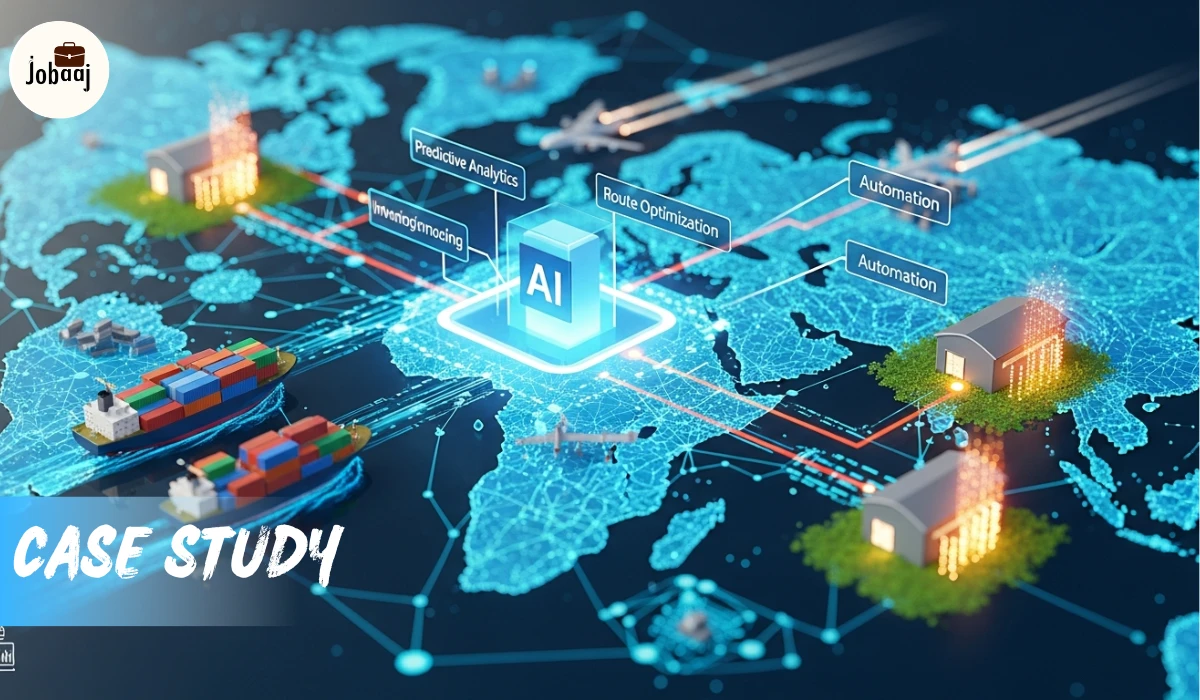
From predictive analytics and demand forecasting to automated warehousing and delivery optimization, AI-powered solutions are reshaping supply chain practices.
Problem/Challenge
Many businesses face significant challenges when it comes to managing their supply chains:
-
Complexity: Supply chains today are more complex than ever, with multiple suppliers, diverse geographies, and an ever-increasing volume of goods being transported.
-
Uncertainty: The global marketplace is volatile, and demand can fluctuate rapidly. Without proper forecasting, companies can either run out of stock or overstock, both of which lead to inefficiency.
-
Costs: The cost of logistics, storage, and handling is high. Companies need to reduce operational costs without compromising service quality.
-
Lack of Visibility: Traditional supply chain models often struggle with visibility. Without real-time tracking, businesses are left blind to potential delays, thefts, or inefficiencies.
To address these problems, AI technologies have proven to be a vital tool in supply chain optimization.
Strategy/Approach
AI technologies are helping businesses streamline their operations in several ways:
-
Predictive Analytics for Demand Forecasting: AI uses historical data and market trends to predict future demand, allowing businesses to better plan their inventory and production processes. Machine learning models can improve the accuracy of demand forecasts, reducing stockouts and overstocking.
-
Intelligent Routing for Deliveries: AI can optimize delivery routes in real-time, accounting for traffic conditions, weather, and other variables. This ensures that deliveries are made more efficiently, reducing fuel consumption and improving delivery speed.
-
Automated Warehousing and Inventory Management: Robotics and AI are being integrated into warehouses to automate tasks such as sorting, picking, and packing. AI-powered systems can also track inventory levels and automatically reorder stock, ensuring that products are always available when needed.
-
Supply Chain Visibility and Transparency: AI-powered tracking and monitoring systems provide businesses with real-time data about shipments, inventory, and delivery status. This transparency helps improve decision-making, identify potential bottlenecks, and enhance customer satisfaction by providing accurate delivery updates.
-
Supplier and Vendor Management: AI helps businesses assess supplier performance, predict potential risks, and identify the best suppliers based on criteria like price, quality, and delivery time. This ensures that companies can maintain strong, reliable supplier relationships.
Innovations Deployed
Several companies have successfully adopted AI in their supply chains. Some notable examples of innovations in AI-powered supply chain optimization include:
-
AI-powered Predictive Maintenance: Companies like General Electric (GE) use AI to predict equipment failures in their manufacturing and supply chain operations. By analyzing data from sensors on machinery, AI can forecast when maintenance is needed, reducing downtime and increasing operational efficiency.
-
Walmart’s AI for Inventory Management: Walmart uses machine learning to optimize its inventory levels and restock products based on predictive demand. By using AI algorithms to analyze historical sales data, the company can ensure the right products are in stock at the right time.
-
Amazon’s Use of Robotics and AI: Amazon has integrated robotics and AI into its warehouses to speed up order fulfillment. AI-driven robots work alongside human employees to pick, pack, and ship products more efficiently, significantly improving productivity.
Findings/Insights
Several key insights emerge from the use of AI in supply chain optimization:
-
Data-Driven Decision Making: AI allows companies to leverage data in a way that was not previously possible, making data-driven decision-making an essential part of supply chain management.
-
Increased Efficiency: AI technologies such as predictive analytics, automation, and intelligent routing significantly improve operational efficiency and reduce human error in supply chain operations.
-
Cost Savings: By optimizing processes, reducing waste, and improving forecasting accuracy, AI can help companies save money on inventory, transportation, and labor costs.
-
Improved Customer Satisfaction: With real-time visibility, faster deliveries, and more accurate inventory management, AI enhances the customer experience, which is critical for business success.
Results
The integration of AI into supply chain management has delivered significant results for businesses:
-
Reduced Costs: Companies like Walmart and Amazon have reduced operational costs by streamlining inventory management, improving delivery efficiency, and automating warehouse tasks.
-
Increased Efficiency: AI-powered predictive maintenance, intelligent routing, and warehouse automation have helped businesses improve efficiency by reducing human error, minimizing downtime, and optimizing resources.
-
Improved Accuracy: AI-powered demand forecasting has allowed companies to better predict customer demand, reducing overstocking and stockouts, and improving the overall supply chain efficiency.
-
Enhanced Customer Experience: Real-time tracking and faster deliveries have led to improved customer satisfaction, with businesses meeting customer expectations more effectively.
Lessons Learned
AI has proven to be a powerful tool in optimizing supply chains, and several valuable lessons can be learned from its application:
-
Embrace Technology: Companies that embrace AI and automation are better positioned to stay competitive in the rapidly evolving marketplace.
-
Data is Key: Real-time data collection and analysis are critical to making informed decisions and optimizing supply chain operations.
-
Invest in AI Talent: To fully leverage AI in supply chain management, businesses need to invest in skilled professionals who can implement and manage these technologies.
-
Focus on Customer Experience: Supply chain optimization should not only focus on reducing costs but also on enhancing the customer experience, which can drive long-term success.
Conclusion
AI has revolutionized supply chain management by providing companies with the tools to improve efficiency, reduce costs, and enhance customer satisfaction. By leveraging technologies like machine learning, predictive analytics, and automation, businesses can optimize their supply chains and stay competitive in a rapidly changing landscape.
As more industries adopt AI-powered supply chain solutions, the future of logistics and operations will continue to evolve, offering businesses new opportunities for growth, efficiency, and customer-centricity.
FAQs
AI in supply chain optimization refers to the use of artificial intelligence technologies, such as machine learning and predictive analytics, to enhance the efficiency, accuracy, and scalability of supply chain processes. AI helps businesses forecast demand, optimize inventory, and improve logistics operations.
AI is used in logistics to optimize routes, improve delivery times, automate warehouses, and reduce operational costs. Machine learning algorithms help predict demand, enabling businesses to adjust their logistics operations dynamically and improve customer satisfaction.
Key benefits of AI in supply chain optimization include improved efficiency, reduced costs, real-time visibility, enhanced forecasting accuracy, and optimized inventory management. It also enables businesses to handle disruptions more effectively and make data-driven decisions.
AI technologies used in supply chain optimization include machine learning, predictive analytics, robotics, autonomous vehicles, natural language processing, and blockchain for enhanced transparency and traceability.
AI improves demand forecasting by analyzing historical data, identifying patterns, and predicting future demand with higher accuracy. Machine learning models continuously improve their predictions, reducing stockouts and excess inventory.
While AI in supply chain optimization can benefit businesses of all sizes, its implementation is most effective for companies with large, complex supply chains. However, with advancements in AI tools and platforms, even small and medium businesses can adopt AI-driven solutions for specific supply chain challenges.