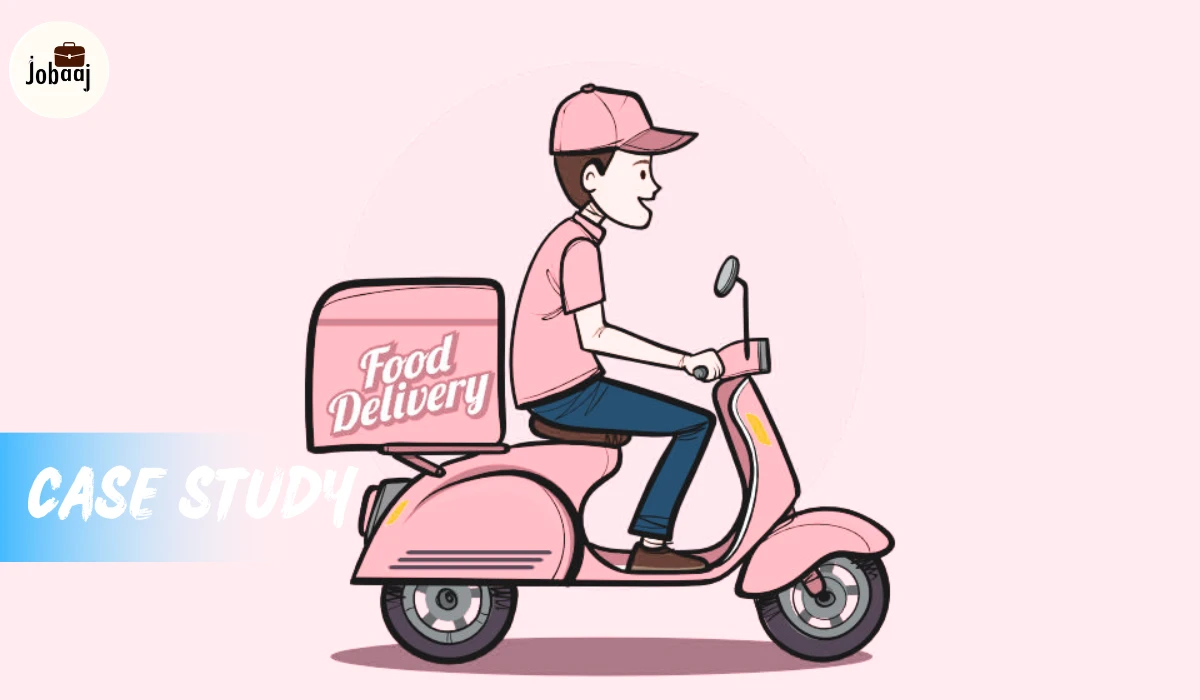
A leading food delivery platform operating in a highly competitive urban market has experienced extremely rapid expansion over the past few years. The company has successfully scaled across multiple cities, built strong restaurant partnerships, and achieved significant increases in daily order volumes.
At a surface level, the business appears highly successful:
- strong user acquisition growth
- increasing monthly active users
- rising order frequency per customer
- expansion into multiple geographic zones
- strong brand recall in urban markets
However, despite this aggressive scale-up phase, internal financial analysis shows a concerning pattern — profitability at the unit level remains weak or inconsistent.
The leadership team is now facing a critical strategic question:
How can a business that is growing so fast still struggle to make money on each order?
This creates a classic growth vs profitability conflict, commonly seen in marketplace and platform-based businesses.
Core Problem Statement
The central problem can be defined as:
Despite strong growth in demand and order volume, the food delivery platform is unable to consistently achieve positive unit economics per order due to high operational costs, aggressive discounting strategies, and structurally low per-order revenue margins.
In simpler terms:
The business is scaling successfully, but each additional order is not contributing enough profit — and in some cases may be generating losses.
This raises concerns about long-term sustainability without continuous external funding or operational restructuring.
Objective
The objective of this analysis is to:
- Break down the full revenue structure per order
- Identify all cost components affecting profitability
- Evaluate unit economics at order level
- Understand structural reasons behind low margins
- Identify key levers to improve profitability without harming demand
Analytical Approach
To solve this problem in a structured manner, we adopt a bottom-up unit economics framework, commonly used in consulting case interviews.
The analysis is divided into five layers:
Step 1: Revenue Breakdown per Order
Understand every possible income stream generated per transaction.
Step 2: Cost Structure Mapping
Identify all direct, indirect, fixed, and variable costs associated with fulfilling an order.
Step 3: Unit Economics Calculation
Compare revenue vs cost per order to determine profitability.
Step 4: Root Cause Identification
Find structural inefficiencies causing negative or weak margins.
Step 5: Strategic Recommendation Design
Suggest operational and strategic improvements for margin expansion.
Revenue Structure Analysis
The food delivery platform generates revenue from multiple interconnected streams, but each has structural limitations.
Restaurant Commission Revenue
This is the core revenue stream where restaurants pay a percentage commission on every order placed through the platform.
However, there are structural constraints:
- restaurants operate on thin margins themselves
- intense competition between platforms limits commission rates
- large restaurant chains negotiate lower commissions
- commission varies by order size and partnership type
As a result, while this is a stable revenue stream, it is not highly scalable in margin terms.
Customer Delivery Fees
Customers are charged a delivery fee based on distance, demand, and order size.
However, this revenue stream faces a major limitation:
- customers are extremely price sensitive
- higher delivery fees reduce order frequency
- platforms often subsidize fees during promotions
Therefore, delivery fees rarely cover the full logistics cost, making it a partial cost recovery mechanism rather than a profit center.
Advertising Revenue from Restaurants
Restaurants pay additional fees to:
- appear at top of search results
- get featured listings
- improve visibility during peak demand periods
This is one of the most important high-margin revenue streams because:
- it does not increase delivery cost
- it scales with platform traffic
- it creates strong monetization leverage
However, it is still secondary compared to core order-based revenue.
Subscription / Membership Revenue
Subscription programs offer:
- free delivery
- discounts on selected orders
- priority customer benefits
This creates recurring revenue, but it also increases:
- order frequency
- discount exposure
- delivery burden
So while it improves retention, it can also increase cost pressure if not balanced properly.
Revenue-Side Insight
Overall, the revenue structure is:
- diversified
- scalable in volume
- but structurally weak in per-order margin contribution
This creates a dependency on high order volume for profitability.
Cost Structure Analysis
Costs are the primary reason behind weak profitability.
Delivery Partner Cost (Highest Cost Component)
Each order requires a delivery executive, making logistics a direct variable cost per order.
Costs include:
- base delivery payout
- distance-based incentives
- surge pricing during peak hours
- performance bonuses for faster delivery
Key challenge:
Unlike digital businesses, this cost scales linearly with every additional order, limiting economies of scale.
Discounting and Customer Acquisition Cost
To drive demand, platforms heavily invest in:
- first-time user discounts
- cashback campaigns
- festival promotions
- free delivery incentives
While effective for growth, this significantly reduces:
net revenue per order
In many cases, discounts are partially funded by the platform itself.
Technology + Operational Costs
These include:
- platform infrastructure and cloud services
- app development and maintenance
- customer support operations
- restaurant onboarding teams
- logistics coordination systems
These costs are semi-fixed and increase with scale but not proportionally with revenue.
Refunds, Failures, and Service Leakage
Operational inefficiencies lead to:
- late delivery penalties
- incorrect orders
- cancellations
- refund payouts
These hidden costs are unpredictable but significant at scale.
Unit Economics Evaluation
Unit economics is defined as:
Profit per order = Revenue per order − Cost per order
Observations:
- Revenue per order is limited due to capped commissions and pricing sensitivity
- Cost per order is high due to logistics + discounts
- Promotional activity reduces effective revenue further
Final Outcome:
In several scenarios, profit per order is extremely low or negative
This means:
Even if the platform grows aggressively, each incremental order does not guarantee profitability improvement.
Key Findings
From the analysis, the core structural issues are:
1. Low margin per transaction
Revenue does not sufficiently exceed operational cost.
2. High logistics dependency
Physical delivery creates unavoidable variable cost pressure.
3. Heavy discount-driven growth model
Customer acquisition is expensive and margin-dilutive.
4. Advertising is the only scalable high-margin lever
Non-core revenue streams contribute disproportionately to profitability.
5. Growth is volume-dependent, not efficiency-driven
Scale alone does not fix unit economics.
Strategic Recommendations
To improve profitability sustainably, the platform should focus on:
Improve Delivery Efficiency at Scale
- optimize route planning
- batch nearby orders
- reduce idle time for delivery partners
- increase delivery density per zone
Goal: reduce cost per order without reducing service quality.
Reduce Dependency on Discounts
- shift users to subscription models
- introduce loyalty-based rewards
- reduce aggressive first-order subsidies
Goal: improve net revenue per user.
Expand High-Margin Advertising Revenue
- increase sponsored listing formats
- improve restaurant targeting tools
- scale premium visibility placements
Goal: increase revenue without increasing delivery costs.
Focus on High-Value Segments
- prioritize high basket-size customers
- target dense urban delivery clusters
- optimize for profitable order mix
Goal: improve average margin per transaction.
Strengthen Unit Economics Monitoring
Instead of only tracking total revenue, focus on:
- profit per order
- city-level profitability
- customer segment profitability
- category-wise margins
Goal: improve decision-making granularity.
Final Conclusion
The food delivery industry represents a classic case of a high-growth, structurally low-margin marketplace model. While demand and scale continue to increase rapidly, profitability remains constrained due to:
- inherently high logistics costs
- aggressive discounting strategies
- limited per-order revenue expansion
However, long-term sustainability is achievable through:
- operational efficiency improvements
- monetization diversification
- reduction in discount dependency
- stronger focus on unit economics discipline
FAQs
Food delivery businesses struggle with profitability because their operating costs are very high. Each order requires delivery personnel, discounts are heavily used to attract customers, and logistics costs increase with every transaction. Even though revenue grows with scale, costs often grow at the same or faster pace, which keeps margins low.
Unit economics refers to the profit or loss made on a single order. It is calculated as revenue per order minus the total cost per order, including delivery cost, discounts, and operational expenses. If this number is negative or very small, the business struggles to become profitable even at large scale.
Food delivery apps earn through multiple revenue streams such as restaurant commissions, delivery fees, advertising, and subscription plans. While delivery revenue alone is weak, advertising and subscriptions help improve overall profitability by adding higher-margin income sources.
These companies focus on long-term scale and market control. By increasing the number of users and orders, they build strong data networks, customer dependency, and brand dominance. The expectation is that profitability can be improved later through efficiency and monetization strategies.
The biggest cost is delivery operations. Every order requires a delivery partner, and companies must pay base fees, incentives, and surge pricing during peak hours. Along with discounts and refunds, logistics becomes the most expensive part of the business.
Yes, but only if they improve unit economics. This includes reducing discount dependency, optimizing delivery efficiency, increasing advertising revenue, and focusing on high-value orders. Profitability depends more on operational efficiency than just increasing order volume.