In 2010, Peyush Bansal quit a job at Microsoft in the United States to sell spectacles on the internet, in a country where almost nobody bought spectacles on the internet.
The scepticism was reasonable. Glasses are not a book or a phone charger. You cannot try them on through a screen, a wrong prescription is not a minor inconvenience, and roughly 90 percent of India's eyewear market ran through neighbourhood opticians who had built decades of local trust that a website had none of. Bansal's first attempt at a pure online model ran into exactly that wall.
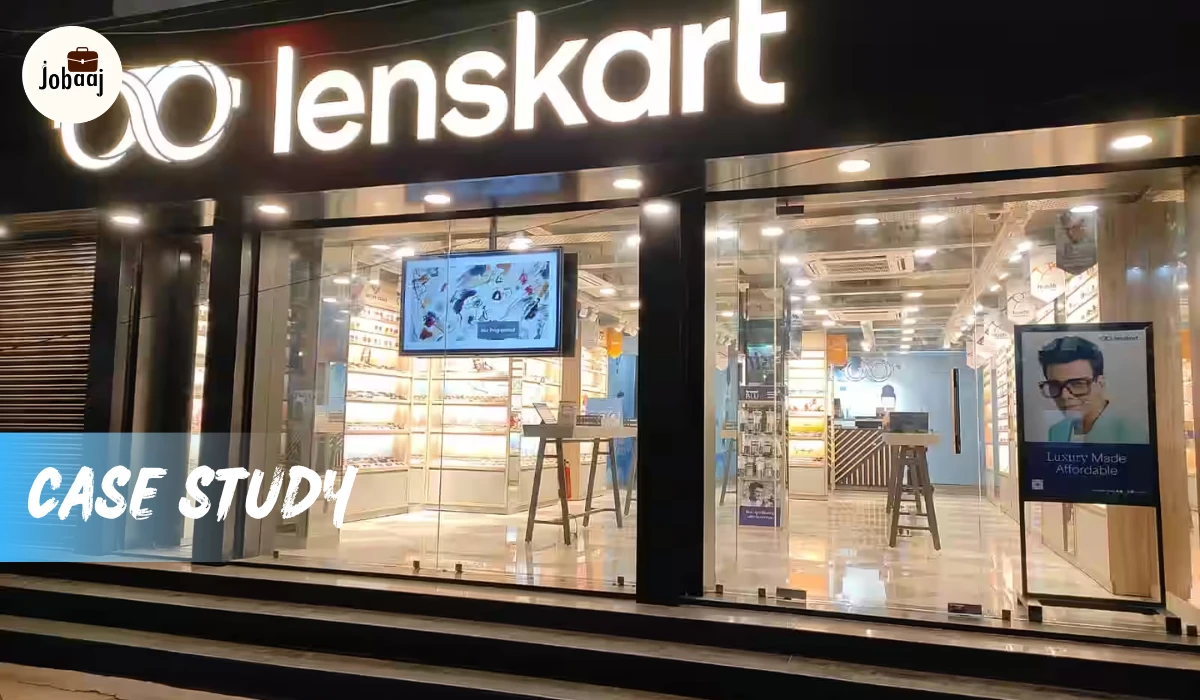
Fifteen years later, the company he built operates more than 2,700 stores, manufactures its own lenses at a factory producing 300,000 frames a month, owns a Japanese retail chain, and went public in November 2025 in a 7,278 crore initial public offering.
It is also, as of that IPO, a company that investors and market commentators have publicly and pointedly questioned on the honesty of its own numbers, in the same month it was being celebrated on business news channels as a great Indian success story. Both things are true at once, and a serious case study has to hold both.
This case study examines how Lenskart solved the specific problem of buying eyewear online in India, why it was forced to become an offline retailer to succeed, how it built a genuinely differentiated omnichannel model, and the uncomfortable questions its IPO raised about the quality of its reported profits.
Company Background
Lenskart was founded in November 2010 by Peyush Bansal, Amit Chaudhary and Sumeet Kapahi, initially under the name Valyoo Technologies, based first in Faridabad and later headquartered in Gurugram.
Bansal's path there was not a straight line. He studied at McGill University in Montreal, worked at Microsoft in the United States, then returned to India around 2007 and experimented with a few ventures, including a portal aimed at solving problems for college students, before landing on eyewear. His own account of the decision is instructive: he has said businesses should be built out of a problem or a passion rather than a model or a channel. The problem he settled on was specific. Buying spectacles in India was expensive, inconvenient, and offered no real quality assurance, and nobody with real technology or capital had bothered to fix it.
The first version of the business was purely online, launching in late 2010 focused on contact lenses before expanding into eyeglasses and sunglasses in early 2011. It was, by most honest accounts, a struggle. Books, electronics and fashion had proven that Indians would buy things online. Eyewear was different in a way that mattered: it required a fitting, a prescription, and a level of trust that a first-time e-commerce buyer in 2011 India simply did not extend to a website for something worn on their face every day.
The company's actual founding insight, then, was not "sell glasses online." It was recognising, the hard way, what pure online could not solve on its own, and rebuilding the business around that recognition rather than abandoning the original ambition.
Business Model: How Lenskart Makes Money
Lenskart runs a vertically integrated, omnichannel retail model, which is a more specific description than "online eyewear company" and matters for understanding why it works.
Revenue comes primarily from prescription eyeglasses, its largest category, alongside sunglasses, contact lenses and accessories, sold across both its website and app and its physical store network.
The stores are a deliberate mix of company-owned and franchise formats. Rather than a conventional franchise where a partner sources independently, Lenskart built what it describes internally as a tech-enabled franchise model: partners operate the storefront, but draw on Lenskart's central inventory, customer data, supply chain and marketing. This let the company scale its physical footprint fast without funding every square foot of retail space itself, while keeping the actual product, pricing and technology experience centrally controlled.
Manufacturing is vertically integrated rather than outsourced. Lenskart operates its own lens-cutting and frame manufacturing, including a factory in Bhiwadi, Rajasthan producing around 300,000 frames a month. Owning manufacturing does two things for the model: it protects margin that would otherwise go to a third-party supplier, and it gives Lenskart control over turnaround time, which matters enormously for a product people often need urgently.
Private label brands widen the price ladder. Vincent Chase, John Jacobs, Hustlr and others let the company serve a value-conscious first-time buyer and a premium repeat customer from the same supply chain, rather than competing only at one price point.
International expansion runs through acquisition rather than only organic build. The 2022 purchase of Owndays, a Japanese eyewear chain, brought Lenskart more than 470 stores across roughly 13 countries in Asia-Pacific in one move, alongside the operational learning of a much more mature eyewear retail market.
The mechanism tying this together is the same one that makes any vertically integrated retailer work. Owning manufacturing, owning the store experience, and owning the customer data from both online and offline touchpoints means Lenskart captures margin at every stage that a pure online marketplace or a pure retail chain would each give up at a different point.
The Core Problem, and Why Pure Online Failed First
It is worth stating plainly why the company's first approach did not work, because the pivot that followed is the most instructive part of this case study.
Eyewear has a trust and fit problem that books and phones do not. A wrong prescription is not a return-and-refund inconvenience, it is a genuinely bad experience for the person wearing it. A frame that looks fine in a product photo can look wrong on an actual face, and most first-time online buyers in India in 2011 had no way to resolve that uncertainty except walking into a shop.
Roughly 90 percent of India's spectacles market was, and largely remains, unorganised, served by local opticians with no supply chain integration and no shared technology, but with something a new website could not manufacture quickly: local trust built over years of relationships.
So Bansal's team tried an intermediate step before building physical stores at scale. In 2013, the company launched a home eye check-up and home trial service, sending an optometrist or a sales executive to a customer's home with a selection of frames. It was a clever, capital-light way to collapse the try-on problem without yet committing to retail leases, and it validated that customers would trust the brand once the physical fitting problem was solved in some form.
The company opened its first physical store in Delhi in 2013. From there, the shift into a genuine omnichannel model accelerated through 2014 to 2018, moving from a company that sold online with a small physical presence to one where the store network became a first-class part of the strategy, not an afterthought.
Timeline
2007
Peyush Bansal returns to India from the United States after working at Microsoft, and experiments with early internet ventures while pursuing management studies at IIM Bangalore.
November 2010
Lenskart is founded by Peyush Bansal, Amit Chaudhary and Sumeet Kapahi, initially as Valyoo Technologies, launching first with contact lenses.
Early 2011
The company expands into eyeglasses and sunglasses. Growth is slower than hoped, exposing the trust and fit problems inherent in selling prescription eyewear purely online in a market with no e-commerce habit for the category.
2011
Lenskart raises an early round of funding, roughly 4 million dollars, from IDG Ventures India.
2013
The company launches home eye check-ups and home trials to solve the try-on problem without yet building a large store network, and opens its first physical retail store, in Delhi.
2014 to 2016
Lenskart pivots decisively toward an omnichannel model, launching its first franchise store and scaling the network aggressively, reaching roughly 250 stores across 80 cities by 2016, alongside a Series C round led by TPG Growth and TR Capital.
2016 to 2018
The company rolls out 3D and augmented reality virtual try-on technology, raises further institutional capital to fund offline scaling, and builds out its private label portfolio, including Vincent Chase and John Jacobs, to widen its price range and improve margins.
2020
Lenskart raises 220 million dollars from Temasek and Falcon Edge Capital at a valuation of 2.5 billion dollars, alongside an earlier round from KKR, having sold around 8 million pairs of eyewear the previous year.
2022
Lenskart acquires a majority stake in Owndays, a Japanese eyewear chain, for around 400 million dollars, adding more than 470 stores across roughly 13 Asia-Pacific markets in a single move.
FY2023
Reported revenue reaches roughly 3,788 crore rupees, well ahead of the eyewear segment revenue of its closest organised competitor, Titan Eye Plus.
FY2024
Reported revenue reaches roughly 350 million dollars, with the company continuing to scale past 1,100 stores.
July 2025
Peyush Bansal acquires shares from existing investors at a valuation of roughly 8,500 crore rupees, funded in part by a personal loan of around 200 crore rupees, a transaction that later draws scrutiny once the IPO price is set.
FY2025
Lenskart reports revenue of roughly 6,652 crore rupees and net income of roughly 297 crore rupees, a sharp swing from a loss of around 10 crore rupees the previous year. Analysts later note that a meaningful share of that profit, roughly 167 crore rupees, came from a one-time, non-cash accounting gain rather than operating performance.
November 10, 2025
Lenskart lists publicly, raising 7,278.76 crore rupees through a combination of a fresh issue of 2,150 crore rupees and an offer for sale of 5,128 crore rupees by existing shareholders, at a price band of 382 to 402 rupees per share. The IPO values the company at a price-to-earnings ratio of roughly 285 times on reported earnings.
2026
The company expands its store count past 2,700 and enters China as a new international market, alongside its established presence in Singapore, the UAE and, through Owndays, Japan and the wider Asia-Pacific region.
Business Impact and Results
Figures below are drawn from company disclosures, the IPO prospectus, and financial media reporting, and are presented with the hedges the underlying sources themselves carry, since several figures are contested.
Scale
| Metric | Figure |
| Store count, 2026 | 2,700+ across India and international markets |
| Store count, FY23 for comparison | Roughly 2,067 |
| International presence | Singapore, UAE, Middle East, Japan (via Owndays), and China as of 2026 |
| Owndays footprint | 470+ stores across roughly 13 Asia-Pacific markets |
| Manufacturing capacity | Roughly 300,000 frames a month at its Bhiwadi facility |
| Share of India's organised eyewear market | Reported at close to 30 percent |
| Total funds raised before IPO | Approximately 850 million dollars |
Financial
| Metric | Figure |
| FY23 revenue | Roughly 3,788 crore rupees |
| FY24 revenue | Roughly 350 million dollars |
| FY25 revenue | Roughly 6,652 crore rupees |
| FY25 net income | Roughly 297 crore rupees, up from a loss of roughly 10 crore rupees in FY24 |
| Share of FY25 profit from a one-time non-cash item | Roughly 167 crore rupees, per post-IPO analyst commentary |
| IPO size, November 2025 | 7,278.76 crore rupees |
| IPO price-to-earnings ratio | Roughly 285 times reported earnings |
| Valuation implied by Bansal's July 2025 share purchase | Roughly 8,500 crore rupees |
The single most important pair of numbers in this table sits close together in time and far apart in scale. In July 2025, Peyush Bansal bought shares at a valuation of roughly 8,500 crore rupees. Within roughly three months, the IPO priced the company at a level implying a valuation many multiples higher. No acquisition, no operational breakthrough and no major market expansion occurred in that window to explain a jump of that size, which is precisely why the transaction drew the scrutiny it did.
Key Findings
1. A category with a trust and fit problem cannot be solved by e-commerce alone
Lenskart's first attempt failed not because online retail does not work in India, but because eyewear specifically required a physical resolution to prescription accuracy and fit that a product photo and a return policy could not substitute for. The lesson generalises: before copying a pure-online playbook into a new category, identify what physical or trust-based friction that category carries that books, electronics or apparel did not.
2. The pivot to omnichannel was not a retreat, it was the actual insight
It is tempting to read Lenskart's story as "online company builds stores because online did not work." The more accurate reading is that the company discovered its real competitive advantage was combining technology-driven pricing and supply chain efficiency with a physical trust layer, and that combination, not either channel alone, is what unorganised local opticians could not match.
3. Vertical integration protects margin and turnaround time simultaneously
Owning manufacturing did not just improve unit economics. It gave Lenskart control over the one thing that matters most to an anxious first-time customer buying prescription eyewear: how fast and how reliably they get it right.
4. A tech-enabled franchise model scales physical presence without the full capital burden
Letting franchise partners run the storefront while Lenskart controls inventory, data, pricing and marketing let the company reach thousands of stores far faster than a fully company-owned model would have allowed, while still keeping the customer experience consistent.
5. Acquisition can be a faster route to international scale than organic expansion
The Owndays purchase delivered hundreds of stores across more than a dozen markets in one transaction, along with operational knowledge from a more mature eyewear retail environment, something that would have taken years to replicate market by market from scratch.
6. Reported profit and the quality of that profit are two different questions
Lenskart's FY25 swing to profitability made for a strong headline ahead of its IPO. The detail that a substantial share of that profit came from a one-time, non-cash accounting item is the kind of thing a genuinely careful reader has to look for, because it does not show up in the headline number at all, only in analysis that goes a layer deeper.
The IPO Controversy: What the Critics Actually Argued
A case study that only covers Lenskart's growth story would be incomplete, because its most recent chapter is defined as much by scrutiny as by success.
The valuation jump is the central concern. Peyush Bansal purchased shares from existing investors in July 2025 at a valuation of roughly 8,500 crore rupees, reportedly funding the purchase partly through a personal loan of around 200 crore rupees. Within about three months, the IPO priced the company at a level implying a valuation described by market commentators as many multiples higher, without a corresponding operational event, such as a major acquisition or market breakthrough, that would obviously justify it. Critics have characterised this as the company's early insiders positioning themselves to profit from the gap between the private transaction price and the public offering price, rather than the jump reflecting genuine business improvement in that window.
The composition of the IPO itself drew comment. Of the total offer, roughly 70 percent was an offer for sale, meaning proceeds went to existing shareholders exiting or partially exiting their positions, including large investors such as SoftBank, Kedaara Capital and Premji Invest, rather than into the company. Only the remaining fresh issue portion, aimed at funding new company-owned stores, technology and marketing, added new capital to the business itself.
The quality of FY25's reported profit was directly challenged. The headline swing from a loss to a profit of roughly 297 crore rupees was widely reported. Follow-up analysis pointed out that a substantial portion of that profit, roughly 167 crore rupees, came from a one-time, non-cash gain related to a deferred item on the balance sheet, rather than from the underlying retail and manufacturing business becoming meaningfully more profitable.
And the valuation itself, independent of how it was arrived at, was flagged as demanding. A price-to-earnings ratio of roughly 285 times reported earnings, on earnings partly inflated by a one-time item, leaves very little room for the business to disappoint on growth or margin without a sharp correction in the share price.
None of this means Lenskart is not a genuinely large, capable, well-built retail business. The store network, the manufacturing integration and the international expansion are all real. What it means is that the story told around the IPO, a straightforward and inspiring founder journey rewarded by the public markets, was more complicated underneath than the headline, and a careful reader of any similar story should look for the same layer of detail before accepting the clean version.
Risks and Limitations
Valuation risk is now a live, public-market risk rather than a private one. At close to 285 times reported earnings, on profit quality that has already been publicly questioned, the stock has limited room for any slowdown in growth or margin before facing real pressure.
Consumer discretionary exposure cuts against Lenskart in a downturn. Eyewear, particularly the higher-margin premium and fashion segments, is more exposed to consumer belt-tightening than a genuine necessity purchase.
Franchise quality variance is an acknowledged operational risk. A tech-enabled franchise model still depends on thousands of individual operators delivering a consistent experience, and consistency at that scale is genuinely hard to guarantee everywhere.
Competition is intensifying from multiple directions. Titan Eye Plus, backed by the Tata Group's brand strength, Reliance-backed Vision Express, and a wide field of digital-first challengers are all contesting the same organised eyewear opportunity that Lenskart has led.
International execution carries real risk. Entering China in 2026 and continuing to integrate Owndays across more than a dozen Asia-Pacific markets are both genuinely difficult operational undertakings, distinct from the discipline that built the Indian business.
The large offer-for-sale component signals continued reliance on existing investors' confidence rather than fresh growth capital, and it means public shareholders are, to a significant degree, buying out early private investors rather than funding new expansion directly.
Business Lessons From the Lenskart Case Study
Identify the specific friction your category carries before choosing a channel
Lenskart's founders learned by hard experience that eyewear needed a physical trust layer that a website alone could not provide. Before assuming an online-first model will work for any product, ask what a customer specifically cannot resolve without touching, trying or verifying the product in person.
A pivot toward a blended model is not a failure of the original vision
Lenskart did not abandon its ambition to be technology-driven and price-disruptive by opening stores. It found the actual form that ambition needed to take. Founders under pressure to prove a pure digital thesis should recognise that blending channels is often the sophisticated answer, not the compromised one.
Vertical integration is a defensible advantage in categories with trust and turnaround stakes
Owning manufacturing let Lenskart control quality and speed simultaneously, which is difficult for a company relying on third-party suppliers to match, particularly in a category where getting the product wrong has real consequences for the customer.
Read past the headline profit number, always
The gap between Lenskart's reported FY25 net income and the underlying quality of that income is a textbook example of why a single number, however impressive, is never the whole story. This applies as much to evaluating a competitor or a potential employer as it does to an investment decision.
A fast valuation jump with no matching operational event deserves scrutiny, not celebration
The three-month gap between Bansal's private share purchase and the IPO price is the clearest lesson in this case study for anyone evaluating any company's growth story: ask what specifically changed to justify a number moving, and be suspicious of large moves with no clear answer.
Career Lessons for Students and Professionals
For anyone building or evaluating a D2C or retail business, Lenskart is one of the clearest Indian examples of why "online-first" is a starting hypothesis, not a guaranteed strategy, and why the correct channel mix depends entirely on the specific trust and fit problem in a given category.
For finance, equity research and investment banking students, the Lenskart IPO is an excellent, current, real-world case for practising exactly the kind of scrutiny these roles are meant to apply: separating reported earnings from earnings quality, understanding what an offer-for-sale-heavy IPO structure signals, and questioning a valuation jump that lacks a clear operational cause.
For operations and supply chain professionals, the vertical integration story, in-house manufacturing paired with a tech-enabled franchise network, is a strong example of deciding deliberately what to own and what to distribute through partners, rather than defaulting to either extreme.
Conclusion
Lenskart's story contains two honest chapters that are usually told as one.
The first is a genuine, well-executed business-building achievement: a founder who correctly diagnosed a broken, trust-starved market, failed with his first approach, and built the more difficult blended model that the category actually required, all the way to manufacturing his own product and acquiring his way into a dozen new countries.
The second is a public listing whose immediate lead-up featured a valuation that jumped many multiples in roughly ninety days with no clear operational cause, a reported profit substantially inflated by a one-time accounting item, and an offer structure weighted heavily toward existing investors exiting their positions.
A good case study does not have to choose between these two chapters. It has to hold both, because the real lesson is not "Lenskart succeeded" or "Lenskart's IPO was priced aggressively." It is that a genuinely strong underlying business and a genuinely questionable moment of financial storytelling can both be true of the same company at the same time, and telling them apart is exactly the skill this case study exists to practise.
FAQs
Lenskart earns revenue primarily from prescription eyeglasses, alongside sunglasses, contact lenses and accessories, sold through both its website and app and a network of more than 2,700 company-owned and franchise stores. It also owns its manufacturing, including a factory producing around 300,000 frames a month, and holds a majority stake in the Japanese chain Owndays for international revenue.
Eyewear carries a trust and fit problem that categories like books or electronics do not. A wrong prescription is a serious issue rather than a minor inconvenience, and in 2011 India, most buyers had no way to resolve fit and prescription accuracy without physically trying the product, which local opticians could offer and an early e-commerce website could not.
Lenskart combines an online platform with a large physical store network, using a tech-enabled franchise model where partners run individual stores while Lenskart controls central inventory, customer data, supply chain and marketing. Home eye check-ups and 3D virtual try-on technology further reduce the friction of buying prescription eyewear without visiting a store.
Lenskart raised 7,278.76 crore rupees in its November 2025 initial public offering, comprising a fresh issue of 2,150 crore rupees and an offer for sale of 5,128 crore rupees by existing shareholders, at a price band of 382 to 402 rupees per share.
Critics highlighted that Peyush Bansal purchased shares from investors in July 2025 at a valuation of roughly 8,500 crore rupees, and within about three months the IPO implied a valuation many multiples higher with no clear operational event to justify the jump. Analysts also noted that a substantial portion of Lenskart's reported FY25 profit came from a one-time, non-cash accounting gain rather than core business performance.
Lenskart reported net income of roughly 297 crore rupees in FY25, a swing from a loss of around 10 crore rupees the prior year. However, post-IPO analysis found that a meaningful share of that profit, roughly 167 crore rupees, came from a one-time non-cash item, raising questions about the underlying operating profitability behind the headline figure.