
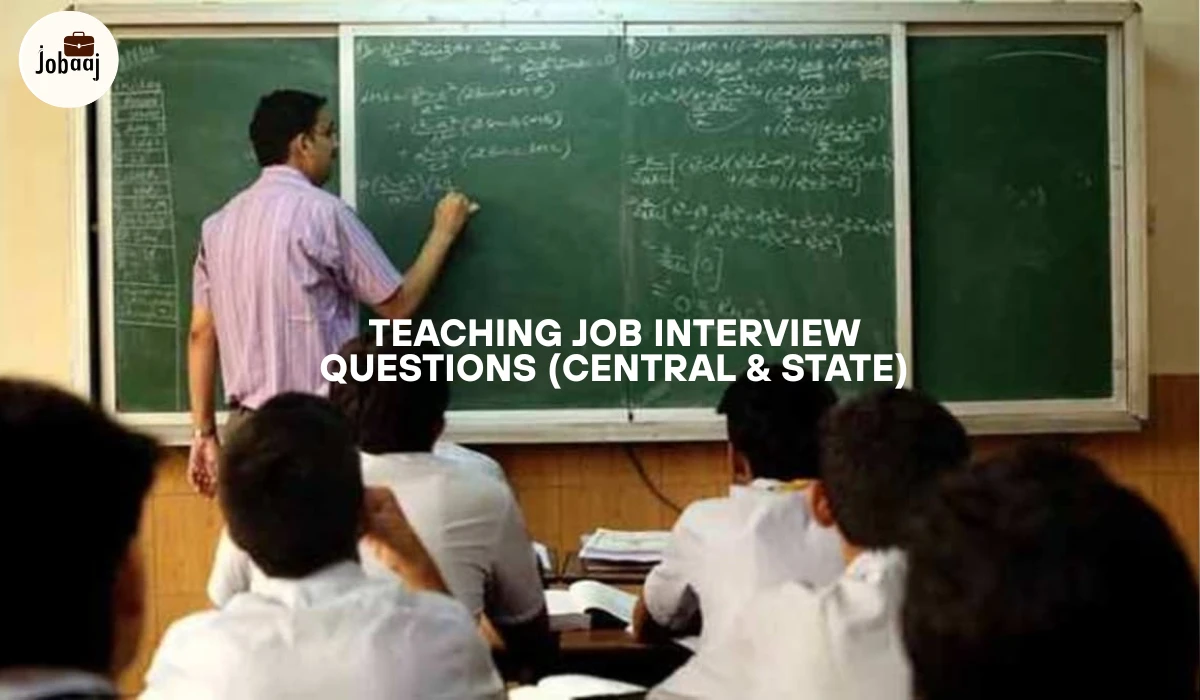
Teaching is one of the most rewarding careers, and securing a teaching job in India whether with a central or state government school requires not only subject knowledge but also effective communication, classroom management skills, and a passion for shaping young minds. The teaching job interview plays a pivotal role in assessing your qualifications, teaching skills, and ability to handle real-world classroom challenges.
In this blog, we will explore the Top 30 Teaching Job Interview Questions that candidates are likely to encounter during interviews for central and state government schools. Along with each question, we’ll provide tips on how to answer and sample responses to help you prepare effectively.
Top 30 Teaching Job Interview Questions (Central & State)
1. Tell us about yourself.
This question is often the first one in any interview. It is your chance to make a strong impression by talking briefly about your qualifications, experience, and passion for teaching.
Sample answer:
"Good morning, Sir/Madam. My name is [Your Name], and I hold a degree in [Your Degree] from [Your College]. I have [X] years of teaching experience, primarily in the [Subject] field, and I am passionate about making learning engaging and accessible for all students. My teaching philosophy is centered on fostering critical thinking and creativity in students, and I aim to create a classroom environment where students feel motivated to learn."
2. Why did you choose teaching as a career?
Explain your motivations for pursuing teaching, focusing on your passion for education and making a difference in students’ lives.
Sample answer:
"I chose teaching because it allows me to influence future generations and contribute to society in a meaningful way. I am passionate about helping students unlock their potential, guiding them to understand not just the subject matter, but also the skills they need to thrive in life. The satisfaction of seeing my students succeed is incredibly fulfilling to me."
3. What is your teaching philosophy?
Discuss your approach to teaching, including how you engage students, foster creativity, and maintain classroom discipline.
Sample answer:
"My teaching philosophy revolves around creating an interactive and inclusive learning environment. I believe in catering to different learning styles and providing students with hands-on experiences. I strive to make my lessons engaging and applicable to real-world scenarios. I also believe in fostering a positive classroom culture where respect, curiosity, and collaboration thrive."
4. How do you handle disruptive students in the classroom?
Talk about your strategies for maintaining classroom discipline while fostering a positive environment for all students.
Sample answer:
"Dealing with disruptive students requires a calm and patient approach. I first try to understand the cause of their behavior by talking to them privately. I then set clear expectations for behavior and ensure that consequences for disruptions are consistent. Additionally, I encourage positive behavior by praising students who follow classroom norms and by incorporating engaging activities that hold students’ attention."
5. What techniques do you use to ensure student engagement in your classroom?
Discuss the methods you use to keep students interested in learning and participating.
Sample answer:
"I use a variety of teaching techniques to engage students, such as interactive discussions, hands-on activities, group projects, and technology-based tools. I also strive to make my lessons relatable to students’ real-life experiences, which helps them see the value of what they are learning. I also encourage questions and foster an open environment where students feel comfortable sharing their ideas."
6. How do you assess student progress and performance?
Explain the methods you use to track students' progress and provide constructive feedback.
Sample answer:
"I use a mix of formal and informal assessments to track student progress. This includes quizzes, assignments, group work, and class participation. I also encourage students to reflect on their own learning. I provide timely, constructive feedback that helps students understand their strengths and areas for improvement. Additionally, I conduct periodic parent-teacher meetings to ensure that students are receiving the support they need."
7. How do you incorporate technology in your teaching?
Discuss how you use digital tools and resources to enhance the learning experience for students.
Sample answer:
"I incorporate technology into my teaching by using tools like PowerPoint, Google Classroom, and educational websites to make lessons more interactive and accessible. I also use educational apps that allow students to explore topics at their own pace. For example, I use videos, online quizzes, and virtual field trips to make abstract concepts more concrete and engaging."
8. How do you handle a situation where students are not performing well?
Talk about how you approach underperforming students and your strategies for providing additional support.
Sample answer:
"When students are not performing well, I first try to identify the underlying cause by observing their behavior, conducting one-on-one sessions, and speaking with parents. Once I understand the issue, I provide extra support, such as additional practice, personalized learning plans, or peer tutoring. I also work to boost their confidence by offering encouragement and acknowledging their progress."
9. How do you make your lessons inclusive for students with special needs?
Explain your approach to making sure all students, including those with special needs, have access to learning.
Sample answer:
"I ensure that my lessons are inclusive by using differentiated instruction, where I adjust the content and teaching methods based on the needs of each student. For students with special needs, I provide additional resources, such as visual aids, extra time for assignments, and one-on-one support. I also collaborate with special education teachers to develop strategies that work for those students."
10. How would you motivate students who are uninterested in learning?
Describe how you engage students who lack motivation and help them discover the relevance of the subject matter.
Sample answer:
"To motivate uninterested students, I try to make the subject more relatable by connecting lessons to real-world applications. I incorporate hands-on activities and group discussions that encourage participation. I also use positive reinforcement and set achievable goals for students, celebrating small victories to help them gain confidence and interest in the subject."
11. How do you manage time during your classes?
Talk about your approach to planning and managing class time to ensure all material is covered efficiently.
Sample answer:
"I believe in being well-organized and planning my lessons in advance. I create a structured timetable that includes time for instruction, student interaction, and assessments. I also make sure to remain flexible so that if some concepts require more time, I can adjust accordingly. I try to ensure that I balance lectures, discussions, and hands-on activities to keep students engaged and the class running on schedule."
12. How do you stay updated with the latest teaching methodologies?
Explain how you continue learning and improving your teaching skills.
Sample answer:
"I stay updated by attending workshops, online courses, and seminars related to teaching methodologies. I also read educational journals and follow pedagogical experts on social media. Additionally, I collaborate with colleagues to exchange teaching strategies and gain fresh perspectives on improving classroom learning."
13. How do you build rapport with students?
Discuss how you foster a positive, trusting relationship with your students.
Sample answer:
"I believe in creating an open and supportive environment where students feel valued. I take time to listen to their concerns, understand their learning styles, and provide encouragement. By showing genuine interest in their academic and personal well-being, I build trust and make students feel comfortable in the classroom."
14. How do you deal with parents and guardians regarding student progress?
Talk about your approach to maintaining good communication with parents and guardians.
Sample answer:
"I maintain regular communication with parents through phone calls, emails, and parent-teacher meetings. I share the student’s progress, strengths, and areas where they need improvement. I believe in keeping parents informed and involved, as their support is crucial for the student’s success. I also listen to their concerns and work collaboratively to find solutions."
15. How would you handle a situation where students are not following classroom rules?
Explain how you would address discipline issues while maintaining a positive classroom environment.
Sample answer:
"I believe in establishing clear classroom rules at the beginning of the year and consistently enforcing them. If students are not following the rules, I address the behavior calmly and privately. I explain the impact of their actions on the classroom environment and work with them to develop better behavior. I also involve parents if necessary to ensure that the issue is addressed effectively."
16. What methods do you use to evaluate your students’ learning?
Discuss the different evaluation methods you use to assess student learning and progress.
Sample answer:
"I use a mix of both formative and summative assessments. Formative assessments include quizzes, assignments, and class activities to gauge ongoing progress. Summative assessments involve final exams or projects that assess overall understanding. I also value peer assessments and encourage students to evaluate each other’s work, which helps them learn from one another."
17. How would you handle the introduction of a new curriculum or teaching method?
Explain how you would adapt to and implement a new curriculum or teaching methodology.
Sample answer:
"I would begin by thoroughly reviewing the new curriculum or teaching method and attending any available training. I would also consult with colleagues to exchange ideas and best practices. Once I understand the new approach, I would implement it gradually, ensuring that students are comfortable with the changes and that I am providing the necessary support to help them succeed."
18. How do you manage stress as a teacher?
Talk about your strategies for maintaining a healthy work-life balance and staying calm under pressure.
Sample answer:
"I manage stress by staying organized, prioritizing my tasks, and setting realistic goals. I also make time for physical activities, such as walking or yoga, to clear my mind. If I’m feeling overwhelmed, I take short breaks during the day to recharge. It’s essential to maintain a balance to avoid burnout and continue delivering quality teaching."
19. How do you ensure that all students are learning at their own pace?
Describe the strategies you use to accommodate students with different learning speeds.
Sample answer:
"I use differentiated instruction by tailoring my teaching methods to meet the needs of each student. For students who require more time, I provide additional resources or one-on-one assistance. For faster learners, I offer more challenging tasks to keep them engaged. I believe that every student should feel supported and challenged according to their own learning style."
20. What are your strengths as a teacher?
Identify your strengths, such as patience, communication, and adaptability, and relate them to your teaching practices.
Sample answer:
"My strength as a teacher lies in my ability to connect with students and create an engaging learning environment. I am patient and adaptable, which helps me support students at different learning levels. I am also an effective communicator, able to explain complex concepts in simple terms, which allows my students to understand and retain information more effectively."
21. How do you handle feedback from parents or guardians about a student’s performance?
Talk about how you handle feedback, both positive and constructive, from parents, and how you use it to improve student performance.
Sample answer:
"I always listen carefully to the feedback provided by parents and guardians. If the feedback is positive, I share the credit with the student and acknowledge their hard work. If the feedback is constructive, I take it as an opportunity for improvement. I ensure that I follow up with parents to show that I am addressing the concerns and making necessary adjustments in the classroom. Open communication with parents is essential to the student’s success, and I always keep them informed about their child's progress."
22. How do you ensure that your students are motivated to learn?
Discuss your strategies for keeping students motivated, such as incorporating engaging activities, setting clear goals, and providing encouragement.
Sample answer:
"I motivate students by making lessons engaging and relevant to their lives. I use interactive teaching methods like group discussions, projects, and hands-on activities to keep students interested. I also set clear, achievable goals for each student and celebrate their successes, no matter how small. Positive reinforcement and showing them the real-world applications of what they are learning help keep them motivated and focused."
23. How do you ensure diversity and inclusion in your classroom?
Explain your approach to creating an inclusive classroom where students from diverse backgrounds feel welcome and supported.
Sample answer:
"I believe that every student should feel valued and included in the classroom, regardless of their background or abilities. To ensure diversity and inclusion, I make sure to use teaching materials that reflect a variety of cultures, experiences, and perspectives. I also incorporate activities that allow students to share their unique experiences and learn from each other. I ensure that all students have equal opportunities to participate, and I provide extra support to those who may need it."
24. What methods do you use to engage students who have different learning styles?
Discuss your approach to addressing the different learning styles in your classroom, such as visual, auditory, and kinesthetic learners.
Sample answer:
"I recognize that every student learns differently, so I use a variety of teaching methods to cater to different learning styles. For visual learners, I use charts, diagrams, and multimedia presentations. For auditory learners, I encourage discussions, storytelling, and auditory resources like podcasts. For kinesthetic learners, I incorporate hands-on activities and experiments. By diversifying my teaching techniques, I can ensure that all students have the best opportunity to succeed."
25. How do you approach teaching students with special needs?
Explain your approach to making learning accessible to students with special needs by providing necessary accommodations and support.
Sample answer:
"I approach teaching students with special needs by first understanding their specific needs and challenges. I collaborate with special education teachers and use individualized learning plans to ensure that these students receive the support they require. I provide extra time for assignments, use visual aids, and adapt teaching methods to suit their learning styles. I also make sure that the classroom environment is welcoming and supportive, and that students feel comfortable asking for help when needed."
26. How do you incorporate real-world learning into your teaching?
Discuss how you make your lessons more applicable to real-world situations, connecting academic content to everyday life.
Sample answer:
"I incorporate real-world learning by showing students how the concepts they are learning can be applied in daily life. For example, I connect mathematical concepts to financial literacy, using budgeting and saving as examples. I also encourage students to look for opportunities to apply their knowledge outside the classroom, such as through community projects or internships. Making learning relevant to students’ lives helps them see the value of education."
27. What are the key challenges facing education in India today?
Discuss major challenges in the education sector, such as accessibility, teacher shortages, digital divide, and lack of infrastructure, and suggest potential solutions.
Sample answer:
"Some of the key challenges facing education in India include the digital divide, where many students in rural areas do not have access to quality online education resources. Teacher shortages and inadequate teacher training also hinder the quality of education in some regions. Additionally, there is a need for better infrastructure in many schools. Solutions could include increasing investment in teacher training, improving infrastructure, and leveraging technology to provide education to underserved areas."
28. How do you handle classroom disruptions without compromising the learning environment?
Explain your strategy for handling disruptions in a way that maintains a positive and productive learning environment.
Sample answer:
"I believe in addressing disruptions calmly and consistently. I first try to understand the cause of the disruption, whether it’s behavioral or related to a student’s needs. I maintain clear classroom rules and expectations, and if a disruption occurs, I calmly remind the student of the rules. If necessary, I will speak to the student privately to address the issue and find a solution. I also ensure that the rest of the class remains engaged and focused during the discussion."
29. How would you deal with a situation where a student is not performing well academically?
Discuss how you would identify the reasons behind a student’s poor performance and take corrective action.
Sample answer:
"If a student is not performing well academically, I would first try to understand the underlying causes. I would talk to the student to identify any challenges they are facing, such as difficulties with the material or personal issues. Based on this conversation, I would offer additional support, such as one-on-one tutoring, extra resources, or modifying the pace of instruction. I would also keep parents informed and work together with them to provide the student with the necessary support both at school and at home."
30. How do you keep yourself motivated in your teaching career?
Talk about what keeps you passionate about teaching and how you overcome challenges in the profession.
Sample answer:
"My motivation comes from seeing the impact I have on my students’ growth and development. Every time a student grasps a concept they struggled with or succeeds in their goals, it reminds me why I chose teaching. I also stay motivated by continuously improving myself professionally, attending workshops, and connecting with other educators to share ideas and challenges. The opportunity to make a positive difference in my students’ lives keeps me inspired every day."
Conclusion
Successfully navigating a Teaching Job Interview for central or state positions requires more than just subject knowledge. It’s about showcasing your teaching philosophy, communication skills, and ability to handle diverse classroom situations. The 30 questions provided in this blog serve as a comprehensive guide to help you prepare for various aspects of the interview, from classroom management and student engagement to handling feedback and adapting to changes.
By reflecting on these questions, practicing your answers, and tailoring them to your own experiences, you’ll be well-prepared to present yourself as a strong candidate. Remember, confidence and passion for teaching are key. With the right preparation, you’ll be ready to demonstrate your ability to inspire and educate students, making a positive impact in the education system.
Good luck with your Teaching Job Interview preparation!
FAQs
Preparing for a teaching job interview involves reviewing common interview questions, researching the school or institution, and practicing answers to questions related to teaching methods, classroom management, and subject expertise. Make sure to also reflect on your personal teaching philosophy and how you engage with students.
A teacher plays a crucial role in shaping students' academic knowledge, personal growth, and future success. Teachers are responsible for delivering lessons, managing the classroom, providing feedback, and guiding students through both academic and personal challenges to help them become well-rounded individuals.
The most important quality of a good teacher is patience. Teachers need to be patient when working with students who are struggling or when challenges arise in the classroom. Other key qualities include strong communication skills, empathy, creativity, and the ability to engage and motivate students.
To maintain discipline, I establish clear expectations from the beginning, apply consistent rules, and ensure that students understand the consequences of their actions. I focus on creating a positive classroom culture where respect and open communication are encouraged, and I handle disruptions in a calm and constructive manner.
Staying motivated as a teacher comes from seeing the growth and progress of my students. Their success, whether big or small, serves as a reminder of why I became a teacher. I also keep myself motivated by continuously learning, attending professional development workshops, and seeking feedback to improve my teaching methods.