
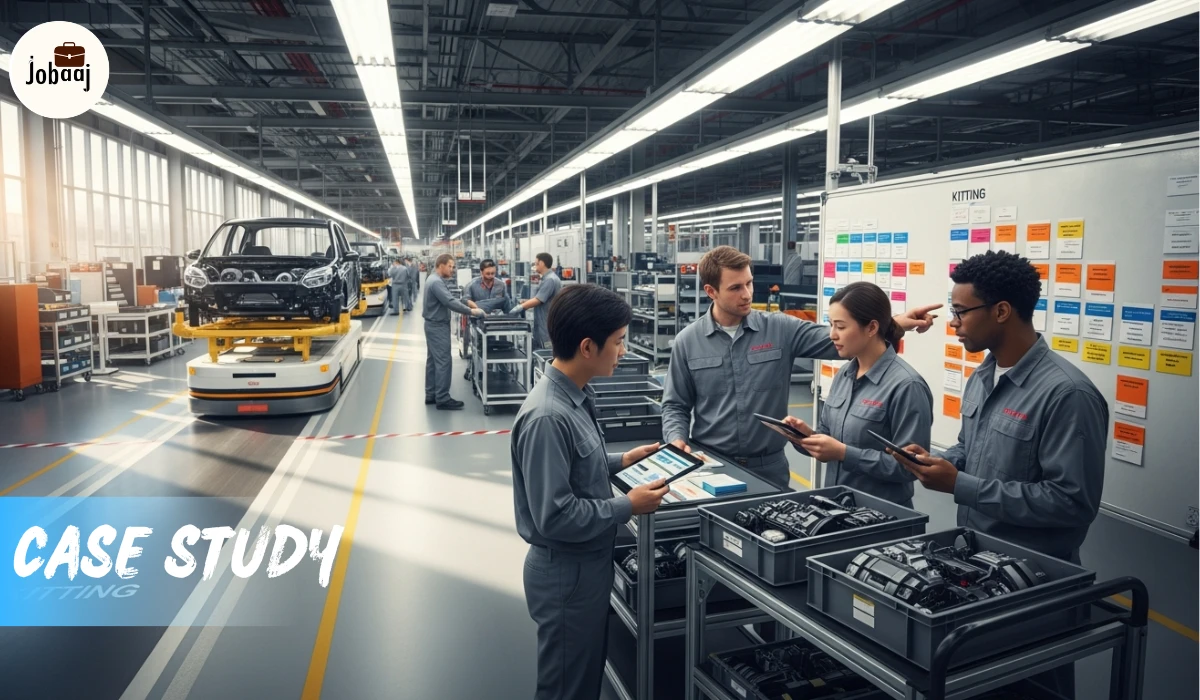
Toyota isn’t just one of the world’s largest automakers it’s the company that transformed how the world thinks about manufacturing. Decades before “efficiency” became a business buzzword, Toyota pioneered a new way of working called Lean Manufacturing. This model didn’t just deliver better productivity and quality for Toyota; it reshaped global manufacturing standards and influenced businesses far beyond the auto industry.
In this case study, we’ll explore how Toyota developed its Lean model, the challenges it aimed to solve, the key strategies it deployed, and the measurable outcomes that made Toyota an industry benchmark for operational excellence.
Introduction
By the mid 20th century, many manufacturing industries focused on producing high volumes of product at the lowest possible cost. But this often resulted in waste, defects, and inefficiencies that hurt quality and profitability.
Toyota, constrained by limited resources in post World War II Japan, needed a better way not just to compete, but to survive. Out of necessity, Toyota developed what would become known as the Toyota Production System (TPS) a framework focused on eliminating waste, improving quality, and empowering workers.
Over time, this system evolved and inspired what the world now calls Lean Manufacturing a methodology that seeks to deliver maximum value with minimal waste. Today, Lean principles are used across industries including healthcare, technology, logistics, and services.
Problem / Challenges
Toyota faced several structural challenges in the decades after World War II:
1. Resource Scarcity
Japan’s post war economy lacked the abundant capital and raw materials enjoyed by manufacturing giants in the United States. Toyota couldn’t afford to hold large inventories or tolerate waste.
2. Inefficient Production Practices
Traditional mass manufacturing focused on keeping machines running at full capacity even if it created excess inventory. This led to waste, overproduction, and high storage costs.
3. Quality Variability
Defects and rework were common in many factories of the time. Toyota needed a system that could deliver consistent quality even with limited resources.
4. Worker Disengagement
Many production systems treated workers as replaceable cogs rather than idea generators. Toyota saw this limited participation as a barrier to continuous improvement.
To tackle these issues, Toyota needed a radically different approach one that focused on efficiency, quality, and human involvement.
Strategy / Approach
Toyota’s Lean Manufacturing Model was not a single tactic but a holistic operating philosophy built around a set of core principles and practices:
1. Eliminate Waste (Muda)
Toyota identified seven forms of waste overproduction, waiting, transportation, over processing, inventory, motion, and defects. The goal was to continuously remove or reduce these wastes in every process.
2. Just In Time (JIT) Production
Rather than producing in large batches, Toyota produced only what was needed, when it was needed, and in the quantity needed. This minimized inventory, reduced storage costs, and improved cash flow.
3. Jidoka (Automation with a Human Touch)
Instead of running machines at full speed regardless of quality, Toyota empowered machines and workers to stop the line if a defect was detected. This ensured that quality problems were solved immediately rather than passed down the line.
4. Kaizen (Continuous Improvement)
Toyota encouraged all workers from the shop floor to management to identify and implement small improvements every day. This created a culture of collective problem solving and innovation.
5. Standardized Work
Work tasks were standardized to ensure consistency and quality across shifts and operators. This also made it easier to identify deviations and implement improvements.
6. Respect for People
Toyota viewed employees as partners in improvement. Training, open communication, and mutual respect were foundational, encouraging people to contribute ideas and take ownership of processes.
Lean Tools and Techniques Deployed
Toyota’s model included a suite of tools and practices that worked together:
-
Kanban- A visual signaling system that triggers production only when needed.
-
5S System- Workplace organization (Sort, Set in order, Shine, Standardize, Sustain).
-
Value Stream Mapping- Mapping processes to identify waste and opportunities for improvement.
-
Poka Yoke- Mistake proofing devices and techniques to prevent defects.
-
Root Cause Analysis (5 Whys)- Digging deep into problems to find and eliminate causes rather than symptoms.
Findings / Insights
After implementing Lean principles, Toyota observed several key insights:
1.Lean Isn’t Just Cost Cutting- It’s Value Creation
By focusing on eliminating waste and improving quality, Toyota wasn’t merely cutting costs it was delivering higher value to customers through better products and faster delivery.
2.People Are the Greatest Asset
Toyota’s commitment to employee involvement and continuous improvement created a culture where workers were not just executors but problem solvers. This led to innovations that management alone might never have discovered.
3.Incremental Improvements Add Up
Small, day to day improvements created through Kaizen compounded over time into exponential gains in efficiency and quality.
4.Standardization Enables Innovation
By standardizing work processes, Toyota created a baseline that made deviations visible. This clarity made it possible for teams to innovate with measurable impact.
Results
Toyota’s Lean Manufacturing Model delivered powerful, measurable outcomes:
1. Reduced Costs and Inventory
Just In Time production slashed inventory levels, freeing up capital and reducing storage and waste costs.
2. Higher Quality Levels
With Jidoka and mistake proofing techniques, Toyota achieved world class defect rates, earning customer trust and stronger brand loyalty.
3. Faster Production Cycles
Lean eliminated bottlenecks and delays, improving cycle times and making Toyota more responsive to customer demand.
4. Global Competitive Advantage
Toyota’s Lean model became a major competitive differentiator contributing to global leadership in automotive manufacturing efficiency and reliability.
5. Replicable Across Industries
Lean principles proved so effective that companies in sectors like healthcare, software development, retail, and logistics adopted them to improve quality and reduce waste.
Lessons Learned
From Toyota’s journey with Lean Manufacturing, several lessons emerge:
1. Efficiency is Holistic, Not Transactional
True efficiency isn’t about cutting expenses it’s about creating processes that deliver maximum value with minimum waste.
2. People Matter Most
Involving employees and valuing their insights creates better outcomes than enforcing top down directives.
3. Small Improvements Drive Big Outcomes
Continuous, incremental improvements lead to sustainable success, one step at a time.
4. Culture Trumps Tools
Lean tools are powerful only when backed by a culture of learning, respect, and shared accountability.
5. Quality Must Drive Production, Not the Other Way Around
Quality built into the process prevents defects, whereas inspecting defects at the end is costly and ineffective.
Conclusion
Toyota didn’t invent efficiency but it invented a way of thinking about efficiency that transformed the global manufacturing landscape forever.
By focusing on people, eliminating waste, and striving for continuous improvement, Toyota’s Lean Manufacturing Model became an operational philosophy that delivers better quality, faster delivery, and optimized use of resources.
Today, Lean thinking continues to influence organizations around the world, proving that a commitment to excellence one small improvement at a time can create enduring competitive advantage.
FAQs
Toyota's Lean Manufacturing Model, also known as the Toyota Production System (TPS), focuses on eliminating waste and improving production efficiency through principles like Just-In-Time (JIT) and continuous improvement (Kaizen). It integrates quality control, worker empowerment, and strategic resource management to drive productivity and reduce costs.
By applying Lean principles, Toyota has achieved higher production efficiency, lower inventory costs, improved product quality, and faster production cycles. It has also fostered a culture of continuous improvement and employee involvement, giving Toyota a global competitive advantage in the automotive industry.
The key components include:
- Just-In-Time (JIT) production to reduce inventory and improve cash flow.
- Jidoka, which empowers workers to stop the production line when defects are detected.
- Kaizen, or continuous improvement, where all employees contribute to process optimization.
- Standardized work processes to ensure consistency and quality.
Through Jidoka, Toyota allows workers to stop production if they detect a defect. This ensures that problems are addressed immediately rather than passed along the production line. Additionally, mistake-proofing techniques (Poka-Yoke) and ongoing employee training help maintain high-quality standards.
Yes, Toyota's Lean Manufacturing principles have been successfully adopted in various industries such as healthcare, retail, software development, and logistics. The core idea of reducing waste and improving efficiency can be applied to any business process that seeks to enhance value while minimizing unnecessary resources.