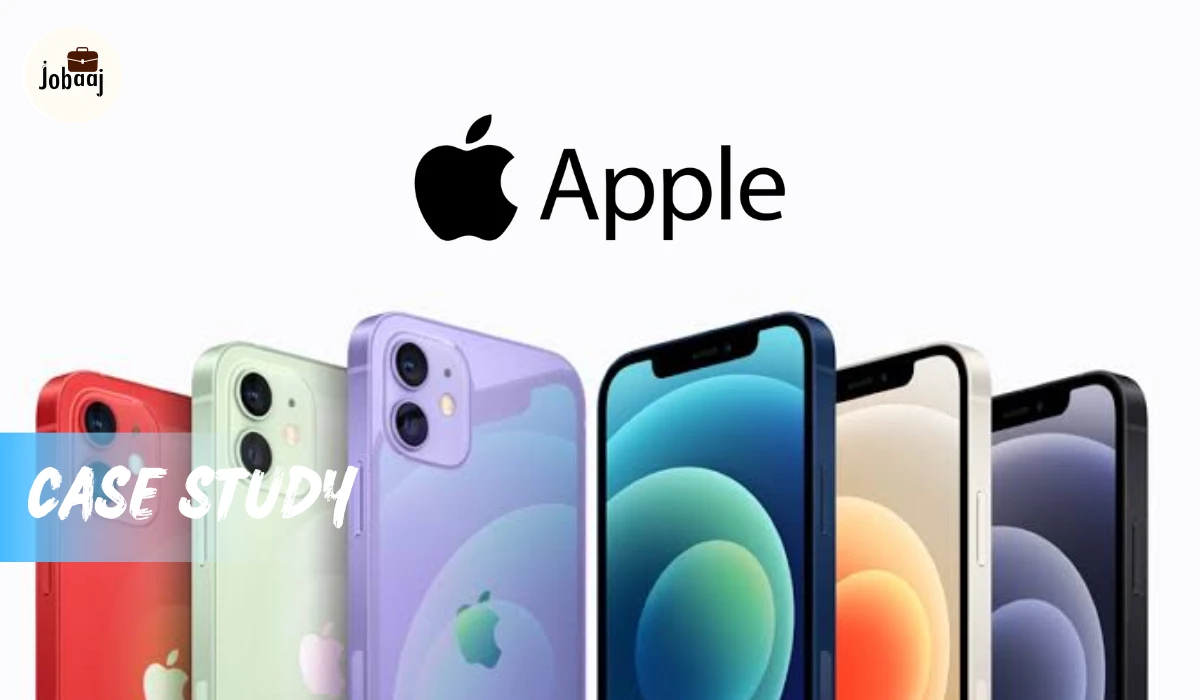
Apple is a case study in turning a commodity product category computers, phones, music players into objects of desire through relentless design discipline, tight ecosystem control, and premium pricing that customers rarely question. This case study traces how a company that nearly went bankrupt in 1997 became the world's most valuable brand, worth over $600 billion, without ever competing primarily on price or specifications.
Introduction
Walk into an Apple Store on a Saturday afternoon and you'll see something strange for a store that sells electronics: people just standing there, touching things, taking photos, not obviously buying anything. That's not an accident. It's the visible result of a three-decade branding strategy that turned Apple from a struggling computer maker into a company people queue outside stores for, camp overnight for, and pay a premium for even when a technically comparable product sits on the shelf next to it for half the price.
This case study looks at how that happened. Not the mythology version "Steve Jobs was a genius" but the specific, repeatable decisions Apple made around design, pricing, retail, and communication that turned a commodity category into a premium one.
Background: A Company on the Brink
It's easy to forget, looking at Apple's current market position, that in 1997 the company was roughly 90 days from running out of cash. Steve Jobs had just returned after an 11-year absence, Apple's product line had ballooned into a confusing mess of overlapping laptops and desktops, and Michael Dell asked what he'd do if he ran Apple famously said he'd shut it down and give the money back to shareholders.
Jobs' first moves weren't about branding in the traditional sense. He cut Apple's product line from roughly 15 models down to four, launched the "Think Different" ad campaign that never once showed a product, and began rebuilding the company around a simple internal question for every decision: does this make the product simpler, or does it make Apple money in the short term? When those two answers conflicted, Apple was told to pick simplicity.
That discipline saying no to far more products, features, and price points than competitors ever would is the seed of everything that followed.
The Problem
By the late 1990s, personal computers had become almost entirely undifferentiated. Windows PCs from Dell, Compaq, HP, and dozens of smaller manufacturers ran the same operating system, used similar components, and competed almost entirely on price and spec-sheet numbers more RAM, faster processor, bigger hard drive. Margins across the industry were thin, and brand loyalty was close to nonexistent; buyers went wherever the best deal was that week.
This was the core problem Apple had to solve, and it wasn't a design problem it was a perception problem. For a premium brand to exist in a commoditized category, buyers need a reason to believe the premium is justified that has nothing to do with the spec sheet. Apple's entire strategy over the next 25 years was, in effect, one long answer to that single problem.
The Strategy
Design as the product, not a feature of the product. Under Jony Ive, Apple treated industrial design as a core differentiator rather than a finishing touch. The unibody aluminum construction, the attention to unboxing, the weight and feel of a device in your hand these became part of what customers were paying for, not decoration around the actual product.
Radical product-line simplicity. While competitors offered dozens of SKUs to cover every price point, Apple deliberately kept its lineup narrow. Fewer choices meant every product got more design and marketing attention, and it made Apple's products easier to understand and desire you weren't choosing between 40 laptops, you were choosing an "Apple laptop."
Owning the full ecosystem. Apple controls hardware, operating system, App Store, and increasingly its own chips (the shift to Apple Silicon in 2020 being the clearest recent example). This vertical integration lets Apple polish the experience end-to-end in a way competitors assembling components from multiple vendors structurally cannot match and it creates switching costs that keep customers inside the ecosystem once they're in.
Retail as brand theatre. The Apple Store, launched in 2001, was a bet that most analysts at the time thought would fail Gateway had just closed its own retail stores. Instead, Apple built stores with no visible cash registers, open tables to touch every product, and staff trained to solve problems rather than push sales. The store itself became a piece of brand communication, reinforcing that Apple products were premium objects worth experiencing in person.
Pricing as a signal, not just a number. Apple rarely discounts, rarely runs clearance sales, and holds prices firm even under competitive pressure. This isn't just about margin a price that never moves signals confidence, and confidence is part of what customers are buying into.
Marketing built on identity, not specifications. From "Think Different" to the iPod silhouette ads to the iPhone launch keynotes, Apple's advertising has consistently sold a feeling or an identity rather than a spec sheet. Competitors' ads listed processor speeds; Apple's ads showed what your life could look like.
Findings
Looking across Apple's history, a few patterns stand out as the actual mechanics behind the brand's premium positioning:
Category redefinition beats feature competition. Apple rarely won by having the most features. The original iPod wasn't the first MP3 player, and the iPhone wasn't the first smartphone Apple won by making the category simple enough that a mainstream, non-technical buyer could love it, then charging a premium for that simplicity.
Scarcity and anticipation are engineered, not incidental. Product launches are tightly controlled, embargoed, and staged as events. Limited initial availability at launch (whether by design or supply constraint) consistently created queues and media coverage that no paid advertising could replicate at the same cost.
The halo effect compounds across products. A customer who loves their iPhone is measurably more likely to buy a MacBook, then AirPods, then an Apple Watch. Apple's own reporting and multiple industry analyses point to this cross-sell effect as one of the biggest financial engines behind the ecosystem strategy each additional Apple device in someone's life makes leaving the ecosystem more costly and less appealing.
Services now monetize brand loyalty directly. As hardware growth has matured, Apple's Services segment (App Store, iCloud, Apple Music, AppleCare, advertising) has become an increasingly significant profit engine effectively converting decades of brand trust into a recurring revenue stream layered on top of hardware sales.
Results
The financial and brand outcomes of this strategy, sustained over roughly three decades, are hard to overstate:
- Brand value: Apple has been ranked the world's most valuable brand by Interbrand for 13 consecutive years (2025 ranking), with brand valuations from major firms in 2026 placing it above $600 billion comfortably ahead of Microsoft, Google, and Amazon.
- Market capitalization: Apple has repeatedly been the first or among the first public companies to cross the $1 trillion, $2 trillion, and $3 trillion market cap milestones a scale almost entirely underwritten by consistent premium pricing rather than volume-based competition.
- Pricing power: Apple's iPhone has consistently commanded a significantly higher average selling price than the smartphone industry average, while still holding a large share of global smartphone profits a strong indicator that customers are paying for the brand and experience, not just the hardware.
- Customer retention: Independent surveys have repeatedly shown iPhone customer loyalty and repurchase rates well above 90%, among the highest of any consumer electronics brand a direct dividend of the ecosystem and design strategy compounding over years.
Challenges Along the Way
The strategy hasn't been without friction, and it's worth being honest about where it's been tested:
Regulatory pressure on the ecosystem. The same tight control that makes the Apple experience feel seamless, App Store fees, restrictions on sideloading, tight hardware-software integration has drawn sustained antitrust scrutiny in the US, EU, and elsewhere, forcing Apple to open parts of its ecosystem it spent years keeping closed.
Premium pricing meets market saturation. In mature smartphone markets, the pool of customers willing to pay a premium for incremental annual upgrades has grown more price-sensitive, pushing Apple to lean harder on services revenue and longer upgrade cycles to sustain growth.
Design philosophy without Steve Jobs. Apple has had to prove, repeatedly, that its design and brand discipline can survive leadership transitions first after Jobs' death in 2011, and through subsequent changes in design leadership without the brand's premium positioning eroding.
Rising competition on "premium" itself. Brands like Samsung, and more recently a resurgent Nvidia in the broader tech brand rankings, have shown that Apple's premium positioning isn't an unchallengeable moat it has to be actively defended, not just maintained by inertia.
Lessons for Other Brands
Design discipline has to be structural, not decorative. Apple's design advantage doesn't come from having good designers plenty of companies have those. It comes from giving design real authority to say no to features, timelines, and cost-cutting that would compromise the product experience.
Fewer, better options usually beat more choice. Apple's radically narrow product lines run directly counter to the instinct most companies have to cover every price point and use case. Simplicity became a form of premium positioning in itself.
Price is a message, not just a mechanism. How a brand handles pricing discounts, sales, price stability communicates as much about its positioning as any advertisement does. Apple's near-total avoidance of discounting has become part of what makes it feel premium.
Ecosystem lock-in must earn its keep by being genuinely better together, not just harder to leave. The moment ecosystem integration is felt as a trap rather than a benefit, brand goodwill erodes which is exactly why regulators and customers alike have started pushing back on the tighter forms of ecosystem control.
A great brand has to be re-earned with every product cycle. Apple's position looks inevitable in hindsight, but it has required consistent execution across nearly 30 years and multiple leadership transitions a single generation of genuinely disappointing products could unwind decades of premium positioning.
Conclusion
Apple's rise from a company 90 days away from bankruptcy to the world's most valuable brand wasn't the result of a single breakthrough product or a single marketing campaign it was the compounding effect of design discipline, product-line simplicity, ecosystem control, retail experience, and disciplined pricing, sustained consistently over decades. The core insight other brands can actually take from Apple isn't "make beautiful products" it's that premium positioning is built through structural decisions (what you say no to, how tightly you control the experience, how you price) far more than through advertising alone. Technology became desire not because Apple convinced people it was desirable, but because Apple built the entire company around actually being worth desiring.
FAQs
Apple doesn't use one official name for its strategy, but it's widely studied as a premium branding or "aspirational branding" model built on design simplicity, ecosystem lock-in, and pricing that signals confidence rather than competing on cost.
Independent brand valuation firms place Apple's brand value at over $600 billion in 2026, making it the most valuable brand in the world for over a decade running, ahead of Microsoft, Google, and Amazon.
Consistent pricing signals confidence and reinforces premium positioning. Frequent discounting would suggest the original price wasn't truly justified, undermining the perceived value of the brand itself.
The ecosystem (iPhone, Mac, iCloud, App Store, AirPods, Apple Watch) creates a compounding halo effect — owning one Apple product measurably increases the likelihood of buying another, while switching to a competitor becomes progressively more inconvenient.
Elements of it can be replicated design discipline, narrower product lines, consistent pricing but the full effect took Apple nearly three decades of consistent execution to build, and depends heavily on genuinely earning trust through product quality, not just marketing.