Investment banking and private equity are two of the most respected and highest-paying careers in finance. Both involve major transactions, detailed financial analysis, demanding work and intense competition.
But the similarity largely ends there.
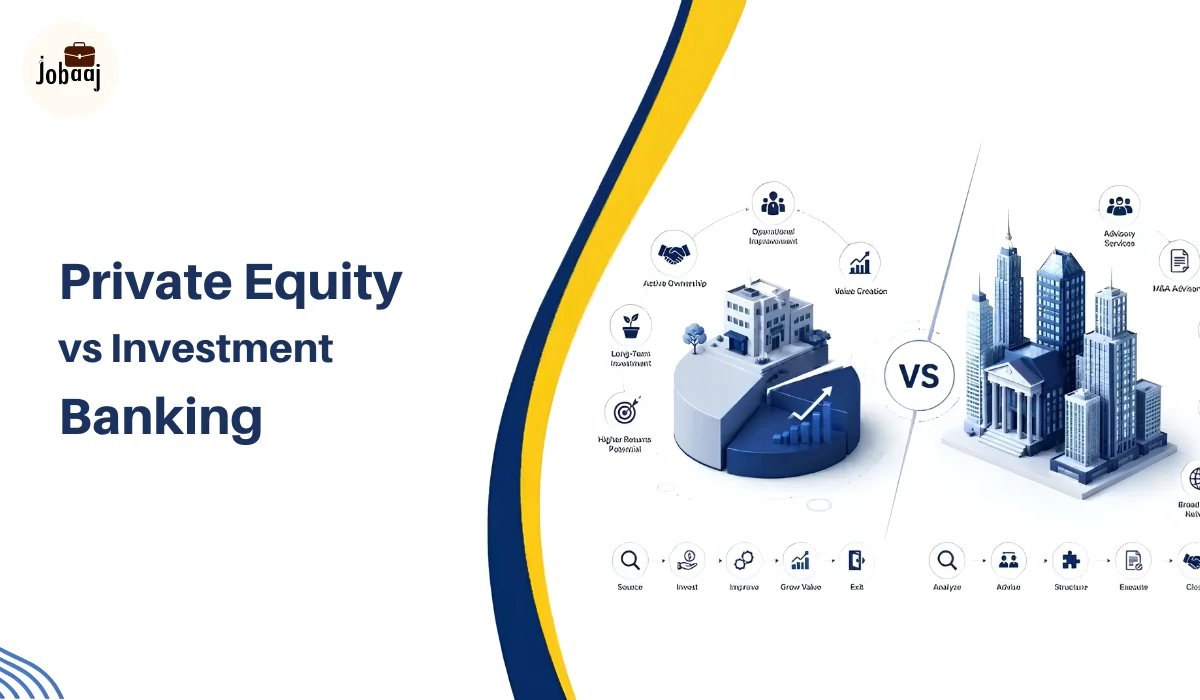
Investment bankers advise companies on transactions. Private equity professionals invest in companies, improve their performance and eventually sell those investments for a profit.
That distinction changes almost everything, including the daily work, recruitment process, risk, career progression and definition of success.
Private equity may appear more attractive because of its investing authority and long-term wealth potential. The weakness in that conclusion is accessibility. Private equity has fewer entry-level positions and usually recruits candidates who already have investment banking, consulting, transaction advisory or investing experience.
Therefore, the better career is not determined by prestige alone. It depends on your career stage, working style, risk tolerance and whether you prefer advising on deals or owning the investment decision.
What is Investment Banking?
Investment banking is a specialised area of finance that helps companies, governments and institutional clients raise capital and complete major financial transactions.
Investment bankers work on mergers and acquisitions, initial public offerings, debt financing, equity fundraising, restructuring and strategic advisory assignments.
For example, if one company plans to acquire another business, an investment bank may help value the target, prepare the financial model, coordinate due diligence, negotiate transaction terms and arrange financing.
The bank earns advisory, underwriting or transaction fees for completing the assignment. It does not normally acquire the company for its own long-term portfolio.
What is Private Equity?
Private equity firms raise money from institutional investors and wealthy individuals to invest in privately held companies or acquire public companies and take them private.
These firms aim to improve the value of a portfolio company over several years. They may expand operations, enter new markets, reduce unnecessary costs, change management, complete additional acquisitions or improve capital efficiency.
The firm eventually attempts to sell its stake through an IPO, strategic sale, secondary transaction or sale to another investment fund.
Private equity professionals are therefore not simply advising a client. They are making an investment decision using their fund’s capital and carrying responsibility for the result.
Core Difference: Adviser vs Owner
The easiest way to understand investment banking vs private equity is to examine who owns the final decision.
An investment banker advises the client, prepares the analysis and supports the transaction. However, the client normally decides whether to proceed.
A private equity professional helps decide whether the fund should invest its capital. If the decision is wrong, the fund may lose money. If it is right, the investment can generate substantial returns.
Investment banking asks:
- How can this transaction be completed?
- What is the company worth?
- How should the deal be financed?
- How can the opportunity be presented to buyers or investors?
Private equity asks:
- Should we invest in this company?
- What could cause the investment to fail?
- How can the business become more valuable?
- What return can the fund earn?
- How and when can the investment be sold?
This makes private equity work more closely connected with investment judgement, while investment banking focuses more heavily on advisory service and transaction execution.
What Does an Investment Banker Do?
Junior investment bankers spend much of their time working with financial information, presentations, industry research and transaction materials.
Typical responsibilities include:
- Building three-statement financial models
- Conducting company and industry research
- Performing comparable company analysis
- Analysing previous transactions
- Preparing discounted cash flow valuations
- Creating pitch books and management presentations
- Supporting financial and commercial due diligence
- Preparing information memorandums
- Coordinating lawyers, accountants and consultants
- Reviewing transaction documents
- Managing deal data rooms
- Responding to senior bankers and client requests
The work can change quickly because clients and senior bankers frequently request revisions. A valuation model that appeared complete in the afternoon may require substantial changes before the next morning.
What Does a Private Equity Professional Do?
Private equity professionals evaluate investment opportunities and monitor companies already owned by the fund.
Their responsibilities may include:
- Screening potential investment opportunities
- Reading information memorandums
- Building leveraged buyout models
- Conducting market and competitor research
- Assessing company management
- Reviewing customer concentration and operational risks
- Coordinating commercial, financial, tax and legal due diligence
- Testing investment assumptions
- Preparing investment committee memorandums
- Negotiating transaction terms
- Monitoring portfolio-company performance
- Supporting acquisition and growth strategies
- Planning future exit opportunities
According to the CFA Institute, private equity roles are highly competitive and commonly require relevant experience. Investment banking and management consulting are among the established routes into the industry.
A Simple Deal Example
Suppose a manufacturing company wants to sell a controlling stake.
The investment bank may prepare the valuation, create the marketing documents, contact potential buyers, manage the bidding process and help negotiate the final deal.
A private equity firm may be one of those potential buyers. Its team will investigate the company, analyse the market, forecast future cash flows, determine how much debt can be used and calculate the expected investment return.
The banker is trying to execute the best transaction for the client. The private equity investor is deciding whether the business is worth buying.
Investment Banking vs Private Equity Skills
| Skill | Investment Banking Importance | Private Equity Importance |
| Financial modelling | Very high | Very high |
| Valuation | Very high | Very high |
| Accounting | High | High |
| PowerPoint presentations | Very high | Moderate to high |
| Client management | Very high | High |
| LBO modelling | Moderate | Very high |
| Investment judgement | Moderate | Very high |
| Due diligence | High | Very high |
| Negotiation | High | High |
| Portfolio management | Low | Very high |
| Sales and relationship building | Very high | High |
| Operational understanding | Moderate | Very high |
Which has a better work-life balance?
Private equity generally has a reputation for somewhat better work-life balance than investment banking. That conclusion requires caution.
A large buyout fund working on a competitive transaction can demand hours similar to investment banking. Smaller funds may have lean teams, meaning each employee carries substantial responsibility.
Therefore, the individual firm and team matter more than the industry label alone.
Investment Banking Salary in India
Investment banking salaries vary significantly across global banks, domestic banks, boutique advisory firms, Big Four teams and support functions.
| Level | Experience | Approximate annual compensation |
| Analyst | 0–3 years | 8– 25 lakh |
| Associate | 3–6 years | 18– 45 lakh |
| Vice President | 6–10 years | 35– 80 lakh |
| Director or Executive Director | 9–15 years | 60 lakh– 1.5 crore |
| Managing Director | 12+ years | 1 crore– 4 crore or more |
These figures represent broad ranges of fixed salary and potential bonus. Front-office roles at top firms may pay considerably more than smaller advisory firms or support roles.
Job titles are not fully standardised. One employer’s associate position may involve different responsibilities and compensation from another employer’s role.
Private Equity Salary in India
Private equity compensation also varies widely by fund size, investment strategy, role, performance and previous experience.
| Level | Experience | Approximate annual compensation |
| Analyst | 0–3 years | 10– 25 lakh |
| Associate | 2–5 years | 20– 50 lakh |
| Senior Associate | 4–7 years | 35– 75 lakh |
| Vice President | 6–10 years | 55 lakh– 1.2 crore |
| Principal or Director | 9–15 years | 90 lakh– 2.5 crore |
| Partner or Managing Director | 12+ years | 1.5 crore– 5 crore or more |
These are directional market estimates, not guaranteed packages. Compensation at a small domestic growth fund may differ sharply from a global buyout fund.
At senior levels, private equity professionals may receive carried interest. This provides a share of qualifying investment profits and can create substantial long-term wealth. However, carried interest is performance-dependent, may take several years to mature and should not be treated like guaranteed annual salary.
Investment Banking vs Private Equity Salary
At junior levels, investment banking and private equity compensation can overlap substantially.
The major difference appears later. Senior private equity professionals can benefit from carried interest, while senior bankers rely more heavily on salary, bonuses and revenue generation.
Investment bankers may earn significant bonuses during strong deal years. Private equity professionals can create greater long-term upside if their fund performs well, but the benefit may be delayed and uncertain.
Salary should therefore not be compared using fixed pay alone.
FAQs
Private equity offers deeper investment involvement and long-term earning potential through carried interest. Investment banking provides more entry-level opportunities, structured transaction training and broader exit options. The better choice depends on your experience, preferred work and long-term career goals.
Freshers can enter private equity through internships or limited analyst programmes, but direct opportunities are rare. Most firms prefer candidates with investment banking, consulting or transaction advisory experience. Starting in investment banking is usually the more practical route.
Both careers offer high compensation. Investment bankers may receive substantial annual bonuses, while senior private equity professionals can earn carried interest linked to fund performance. Private equity offers greater long-term upside, but this income is delayed, uncertain and performance-dependent.
CFA builds useful knowledge in financial analysis, valuation, ethics and investment management. However, it does not replace transaction experience, financial modelling, internships or networking. It is generally more relevant to private equity and investment research than traditional investment banking recruitment.
Investment banking is not compulsory, but it is one of the most established routes into private equity. It develops valuation, modelling, due diligence and deal-execution skills. Candidates may also enter through consulting, corporate development, equity research or transaction advisory.